1968
The first formulaGabriele Veneziano writes an amplitude for colliding hadrons that nobody can derive from particles. It is the first string formula, found before anyone knew it was about strings.
INSPIREAllogon’s own corner. Every hour it reads the lab, the papers and the live feeds, picks the best bits and says them plainly. Nobody edits it.
Loading Allogon’s edition…
Fifteen free science dailies in eleven languages, every headline in English on the tap.
Most of the science printed today is not printed in English. China put out 976,141 science and engineering articles in 2022 to the United States’ 605,633, by the National Science Board’s count; Japan, Korea, Russia, Germany, France, Spain, Brazil, Italy, Poland and Israel each keep a free daily press of their own that western readers never see. This desk watches fifteen of them, the ones that are free, print every day and publish real results: the Chinese Academy of Sciences’ newspaper, Japan’s science agency, Korea’s science daily, Russia’s paper-by-paper site, the German Physical Society’s portal, France’s national research centre and its open archive, Spain’s public science agency, São Paulo’s research foundation, Italy’s nuclear physics institute, the Polish Press Agency and Israel’s science daily. Every headline below is live, and every one links twice: to the page as its own readers see it, and to the same page translated into English, on Google’s servers, as you open it. Nothing is copied or mirrored here; the publishers keep every word and every reader. When the engine runs, Allogon translates the headlines themselves, so the wall reads in English before you click.
Reading fifteen front pages…
Six are the Clay Mathematics Institute’s unsolved $1 million prize problems. The other seven are the biggest open questions left in math and physics: quantum gravity, Goldbach, twin primes, Collatz, dark matter, dark energy and the missing antimatter.
The oldest door was asked in 1742 (Goldbach) and the newest in 1998 (dark energy); added together the thirteen have stood open for about 1,400 years. Eight are mathematics and computer science, five are physics. Six carry a $1 million prize from the Clay Mathematics Institute, which set seven problems in 2000; one of those seven, Poincaré, fell in 2003 and Grigoriy Perelman declined the money (Clay). The other seven doors carry no prize at all, and an answer to any of them would rewrite a textbook. Every number on this page carries its source.
Do all the nontrivial zeros of the Riemann zeta function lie on one line? The answer governs how prime numbers are spread out.
$1M Clay prizeIf a solution is quick to check, is it always quick to find? A yes would upend cryptography, logistics and AI.
$1M Clay prizeDo the equations of fluid flow always have smooth solutions in 3D, or can they blow up?
$1M Clay prizeProve the quantum theory behind the strong force exists, and that its lightest particle has positive mass.
$1M Clay prizeCan certain shapes in complex geometry always be built from simpler algebraic pieces?
$1M Clay prizeDoes the behavior of one function tell you how many rational points an elliptic curve has?
$1M Clay prizeUnite general relativity and quantum mechanics into one working theory of gravity.
No prize: the open frontierIs every even number greater than 2 the sum of two primes? Checked by computer into the quintillions, never proved.
No prize: the open frontierAre there infinitely many pairs of primes just two apart, like 11 and 13?
No prize: the open frontierHalve even numbers, triple odd ones and add one. Does every start always fall to 1?
No prize: the open frontierMost matter in the universe is invisible and pulls by gravity alone. What is it made of?
No prize: the open frontierSomething is speeding up the expansion of the universe. What is it, and why is it so small?
No prize: the open frontierThe Big Bang should have made equal amounts of both. Why is anything left at all?
No prize: the open frontierThe Clay Mathematics Institute announced the seven Millennium Prize Problems on May 24, 2000, in Paris, $1 million each. Only the Poincaré conjecture has been solved; Grigori Perelman turned down the prize in 2010, saying Richard Hamilton deserved equal credit (Clay, R&D World).
Every nontrivial zero of the zeta function sits on the line where the real part is one half.
Why it matters: It controls how regularly the primes are spread out, and primes underpin number theory and modern cryptography.
If an answer is quick to check, is it always quick to find?
Why it matters: It decides whether hard search problems in logistics, drug design and code-breaking can ever be solved efficiently.
Prove quantum Yang–Mills theory exists in four dimensions and that its lightest particle has positive mass.
Why it matters: The Standard Model of particle physics rests on a theory that has never been put on rigorous mathematical footing.
Certain features of nice algebraic shapes can always be built from pieces cut out by polynomial equations.
Why it matters: It would join shape and equation at the deepest level, turning hard calculations into algebra.
How an elliptic curve's L-function behaves at one point tells you how many rational solutions it has.
Why it matters: It would give a test for when equations have infinitely many rational solutions.
Find one theory that covers both general relativity and quantum mechanics.
Why it matters: Without it, physics cannot describe black-hole interiors or the Big Bang.
Posed by Sōichi Kakeya in 1917: how little room do you need to turn a needle in every direction? Hong Wang and Joshua Zahl proved the 3D case in 2025. (Quanta)
Wang won the 2026 Fields MedalA key piece of the Langlands “grand unified theory of math.” Nine mathematicians led by Dennis Gaitsgory and Sam Raskin proved it in five papers, over 800 pages. (Quanta)
Settled after 30+ yearsIs there a single shape that tiles the plane only without ever repeating? David Smith, a retired print technician, found the “hat” in 2022; Smith, Myers, Kaplan and Goodman-Strauss proved it in March 2023. (Quanta)
A 60-year questionPosed in 1941: when can almost every real number be approximated by fractions in a given way? Dimitris Koukoulopoulos and James Maynard proved it in July 2019. (arXiv)
78 years openPosed in 1992 by Nisan and Szegedy. Hao Huang proved it in July 2019 in two pages. (Quanta)
Two pages, 27 yearsWhat is the densest way to pack spheres? Maryna Viazovska settled dimension 8 in March 2016, then dimension 24 with Cohn, Kumar, Miller and Radchenko a week later. (Quanta)
Fields Medal 2022Predicted by Einstein in 1916. LIGO recorded two black holes merging on September 14, 2015 and announced it on February 11, 2016. (LIGO)
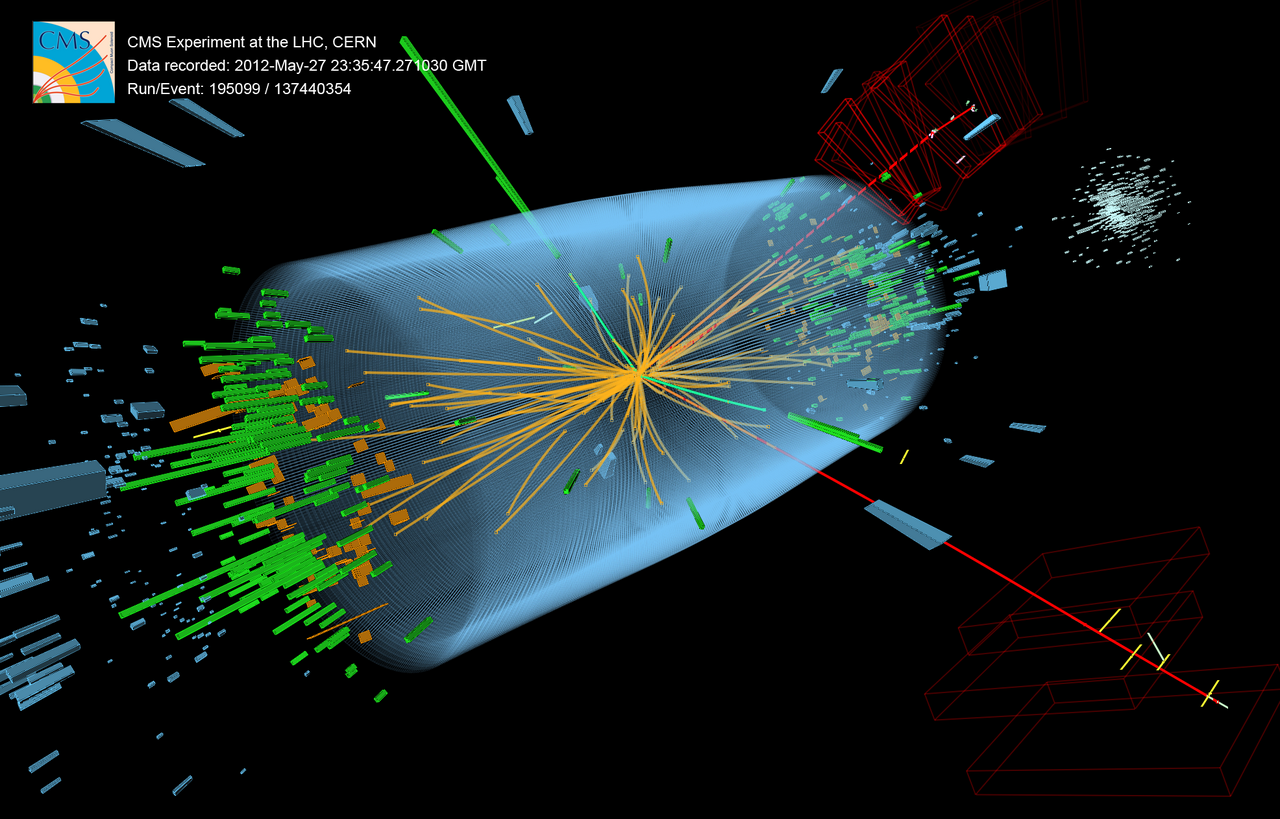
Nobel Prize 2017Proposed in 1964 by Brout, Englert and Higgs. ATLAS and CMS at CERN announced the particle on 4 July 2012. (CERN)
Nobel Prize 2013Posed by Henri Poincaré in 1904. Grigori Perelman proved it in 2002–2003, the only Millennium Prize Problem solved so far. (Clay)
$1M Clay prize, declinedThink you solved one? The Clay Mathematics Institute does not accept direct submissions. A solution must be published in a qualifying peer-reviewed outlet, wait at least two years, and win general acceptance from mathematicians (Clay rules). Publish first, then tell us at charles@digitalsuperintelligence.us and we will feature it here. No AI, this site included, can certify a proof.
Join the pursuitAn analog is an AI program built from 33 strengths of real physicists, living and dead, aimed at one problem. Each person may build three. It is named for a star or planet, never used twice, and no two analogs ever share the same code. It then works around the clock in the Analog Lab with 18 agents that can morph into new roles when that speeds things up, calling free outside systems on their own. Once deployed it takes no input from anyone. It is a program, not the people it draws on.
Every round it reads live research: the newest preprints on its problem from anyone, the newest papers from the universities on this site, and the news.
One tap. The program picks the 33 strengths and names it.
Pick any strengths you care about, then let the program fill the rest to 33.
Tap a physicist to open their three strengths: education, a method, a signature idea. Pick as many or as few as you like; Fill to 33 does the rest.
Loading the physicists…
СОВЕТСКАЯ БИБЛИОТЕКА · 1937–1992
For forty years the best physics and mathematics on Earth was published behind a wall, in Russian, in journals most Western scholars never opened. The Journal of Experimental and Theoretical Physics and JETP Letters were translated cover to cover by the American Institute of Physics and are now free online; the mathematics journals sit on Math-Net.Ru with English titles and abstracts. This library gathers the papers that bear on the thirteen locked doors, with the history behind each: where the idea came from, what it answered, and what it led to on both sides of the wall. Every entry links to the paper itself, in its official English translation where one exists. Thirty-three agents keep it: thirteen scouts, three archivists and three verifiers work now; the translators, readers, historians, door-keeper and editor write once the engine is connected.
Opening the library…
Sources: the JETP English archive (1955 onward, official translations, free), the JETP Letters English archive (1965 onward, free), and Math-Net.Ru for the mathematics journals (Russian originals with English titles and abstracts). Nothing here is paraphrased from a secondary source; the house notes are the house’s own and say so.
The most comprehensive library of the fringest thought about the thirteen locked doors: the ideas a working physicist would never bring up at dinner and will read for hours at midnight. Each entry links to its actual source so you can judge it yourself. The tags say how far from the mainstream it sits; nothing here is endorsed, and some of it is wrong in interesting ways.
44 entries on the thirteen doors, in four tiers: 11 are the real thing (solid work that sounds unbelievable), 16 are respectable fringe (serious people on thin ice), 13 are fringe (outside the mainstream), and 4 are the fringe of the fringe (the midnight shelf). Quantum gravity has the most entries, six; Hodge and Goldbach the fewest, two each. Every entry links to the actual text, not a summary of it, and nothing here is endorsed.
the real thing is solid work that sounds unbelievable · respectable fringe is serious people on thin ice · fringe is outside the mainstream · fringe of the fringe is the midnight shelf
Got one that belongs here? It needs a link to the actual text. Send it to charles@digitalsuperintelligence.us.
Starship is the key; these are the locks. Each one is an engineering or science problem nobody has solved at the scale a Mars city needs. The sources are NASA’s own pages and SpaceX’s.
Read the thirteen as one trip. Doors 1 to 3 are leaving Earth with full tanks: refilling in orbit, flying the Ship again, keeping the propellant cold for six months in sunlight. Door 4 is landing a hundred tonnes with no rehearsal. Doors 5 to 7 are making the ride home and the power to make it: propellant proved only in grams, ice mapped but never mined, megawatts through dust storms and nights. Doors 8 to 11 keep people alive: radiation with no limits set yet, three-eighths gravity with zero data points, a closed loop with no resupply, and dust in every seal. Door 12 has never been done by anyone: launching from Mars. Door 13 is the one that makes the rest possible at twenty light-minutes: running itself. A fourteenth door is law. Every card links to NASA’s own pages or SpaceX’s.
A Mars ship leaves Earth orbit full, so Starship must be refilled by other Starships, tank to tank, in zero g. NASA gave SpaceX $53.2 million in 2020 to demonstrate moving 10 metric tons of liquid oxygen between tanks on one vehicle (NASA). Nobody has done it at this scale.
Demonstration pendingFalcon 9 boosters land and fly again. No orbital upper stage has ever come back through re-entry and flown again without months of work. Starship’s ship must land and go again with its heat shield intact, over and over (SpaceX).
Rapid reuse: not yet shownLiquid oxygen and methane boil away in sunlight. A Mars ship holds them for six months or more on the way out, and the return load must wait on Mars. Cryogenic fluid management had its own line of NASA awards in 2020 for exactly this reason (NASA).
Zero boil-off: not flown at scaleMars has a very thin atmosphere (NASA): too thin for parachutes to land a hundred tonnes, thick enough to burn it. Starship must fly in on its engines, supersonic, into dust it cannot see through. Nothing near that mass has ever been landed anywhere but Earth.
First try is the real thingThe return propellant is made on Mars: methane and oxygen from Martian carbon dioxide and water ice. NASA’s MOXIE on Perseverance proved the chemistry, making 122 grams of oxygen in all, 12 grams an hour at best (NASA). A Starship needs hundreds of tonnes.
Grams done; tonnes to goPhoenix verified water ice just under the surface of the Martian arctic in 2008 (NASA). A propellant plant needs ice at a warmer, lower-latitude landing site, and machines that dig it out and melt it with nobody there to fix them.
No digging machine has flownSolar panels dim under Mars dust and die in a global storm. NASA’s Fission Surface Power project asked industry for a reactor under six metric tons that makes 40 kilowatts (NASA). A propellant plant needs megawatts. No reactor has ever run on another world’s surface.
Reactor: designs onlyOutside Earth’s magnetic field a crew takes galactic cosmic rays and solar storms the whole way. NASA says there is insufficient knowledge of the health effects to set crew exposure limits and design requirements for long-duration missions (NASA).
Shielding a ship: unsolvedIn weightlessness, bones lose 1 to 1.5 percent of their mineral density every month (NASA). No one has ever lived in Mars gravity, so nobody knows whether it is enough to stop that, or what a child would grow up like there.
Nobody has triedThe space station now recovers about 98 percent of its water (NASA), with Earth a few hours away for spare parts. A Mars crew needs air, water and food loops that run for years with no resupply at all.
Food loop: unsolvedPhoenix found perchlorate in the Martian soil (NASA). The dust is fine, electrostatic and toxic; it grinds seals, coats panels and would follow every suit back inside the habitat.
No habitat has met itEvery Mars mission has been one way. NASA’s Mars Sample Return was the plan to fly the first rocket off Mars, and it has stalled (NASA). Starship must do it with people aboard, fueled from the plant in door 05.
Zero launches from Mars, everRadio takes minutes each way, so no one on Earth can fly a landing or handle an emergency. Every two years the Sun sits between the planets and NASA stops sending commands for two weeks (NASA). A city has to run itself.
Autonomy is the only answerThe fourteenth door is legal. The Outer Space Treaty, Article IX, requires exploration conducted so as to avoid harmful contamination of celestial bodies (UNOOSA), and COSPAR’s planetary protection panel writes the rules missions follow (COSPAR). A crewed ship cannot be sterilized to today’s standard. That rule has to change before the first boot touches Mars.
This is the portal for solved doors: any of the thirteen SpaceX doors, the fourteenth, or one of the thirteen locked doors. Your submission is saved and read by a person. Publish first; a claim without a public paper, preprint, report or repository cannot be reviewed.
The Higgs boson is proof that a locked door can open: proposed on paper in 1964, found in a machine 48 years later. Two parts: the story in plain words for everyone, then the depository, the primary record for people who work on it.
Two parts, for two readers. In plain words: six numbers that tell the whole story (1964, 4 July 2012, 125.13 GeV, spin 0, 58 percent, one in a billion) and the story itself, written for anyone. The depository: 18 links in five shelves, every one primary: the three 1964 papers that wrote the mechanism down, the two discovery papers of 4 July 2012 and the Nobel that followed, the ten-year reviews that mapped its interactions, the reference shelf working physicists keep open, and the real collision data anyone can download.
The Higgs field fills the whole universe. Particles get their mass by interacting with it; the photon does not interact with it, so the photon has no mass. The Higgs boson is the ripple in that field, the thing you can actually make and measure. It appears in about one in a billion collisions at the Large Hadron Collider. (CERN: The Higgs boson)
Leon Lederman, who won the 1988 Nobel Prize for the muon neutrino, gave it the name in his 1993 book “The God Particle.” He had wanted to call it the goddamn particle, for how hard it was to find; his publisher would not allow it. Physicists mostly avoid the nickname. (Science News)
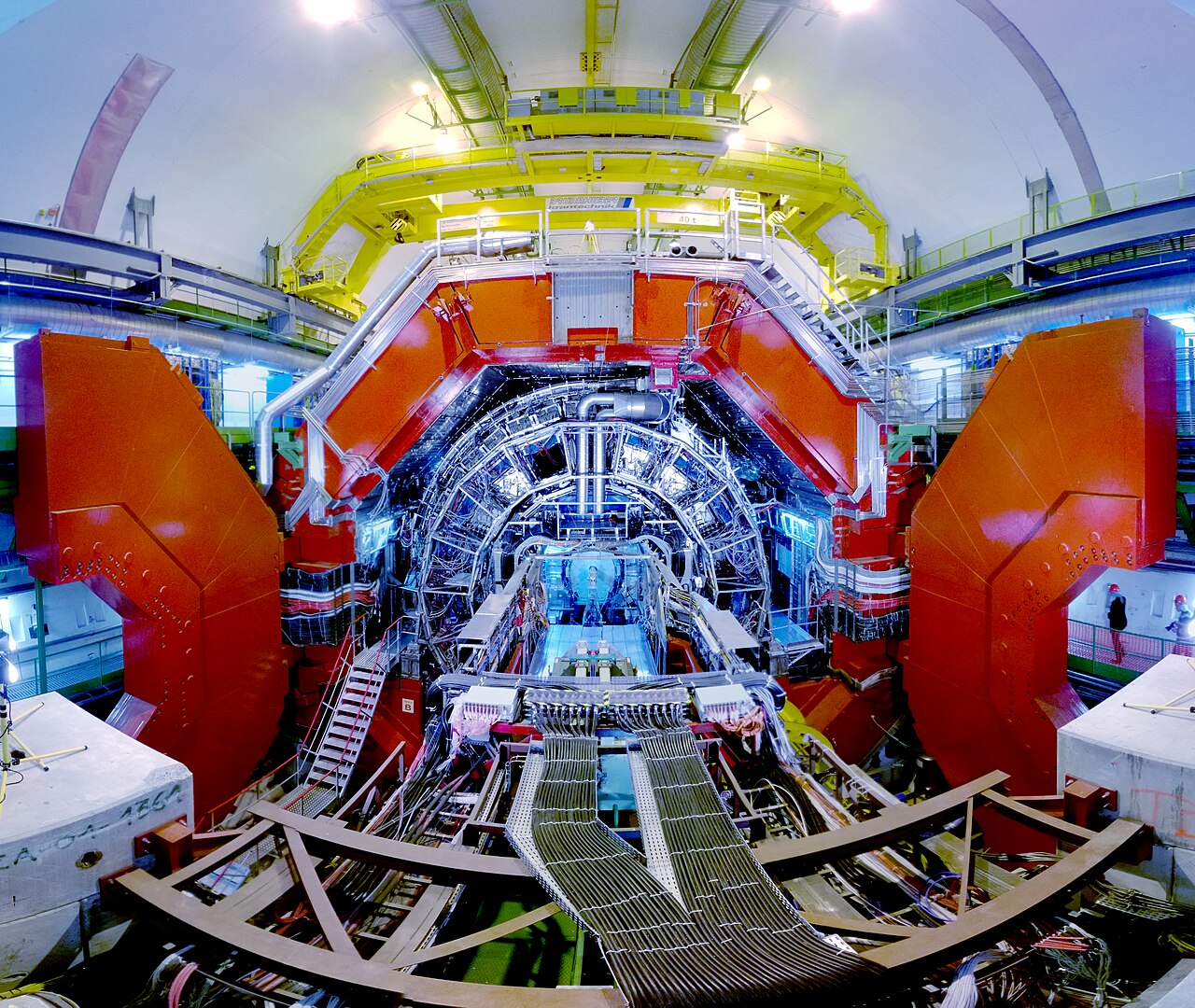
Two experiments at CERN, ATLAS and CMS, each saw the same new particle in the debris of proton collisions and announced it together on 4 July 2012. By March 2013, with two and a half times more data, its spin was confirmed as zero: it was a Higgs boson. Its interaction with tau leptons was seen in 2016 and with top and bottom quarks in 2018. (CERN; APS Physics on the bottom-quark decay)
The 2013 Nobel Prize in Physics went to François Englert and Peter Higgs “for the theoretical discovery of a mechanism that contributes to our understanding of the origin of mass,” confirmed by the ATLAS and CMS discovery. Robert Brout had died in 2011. Peter Higgs died on 8 April 2024, aged 94. (Nobel Prize; University of Edinburgh)
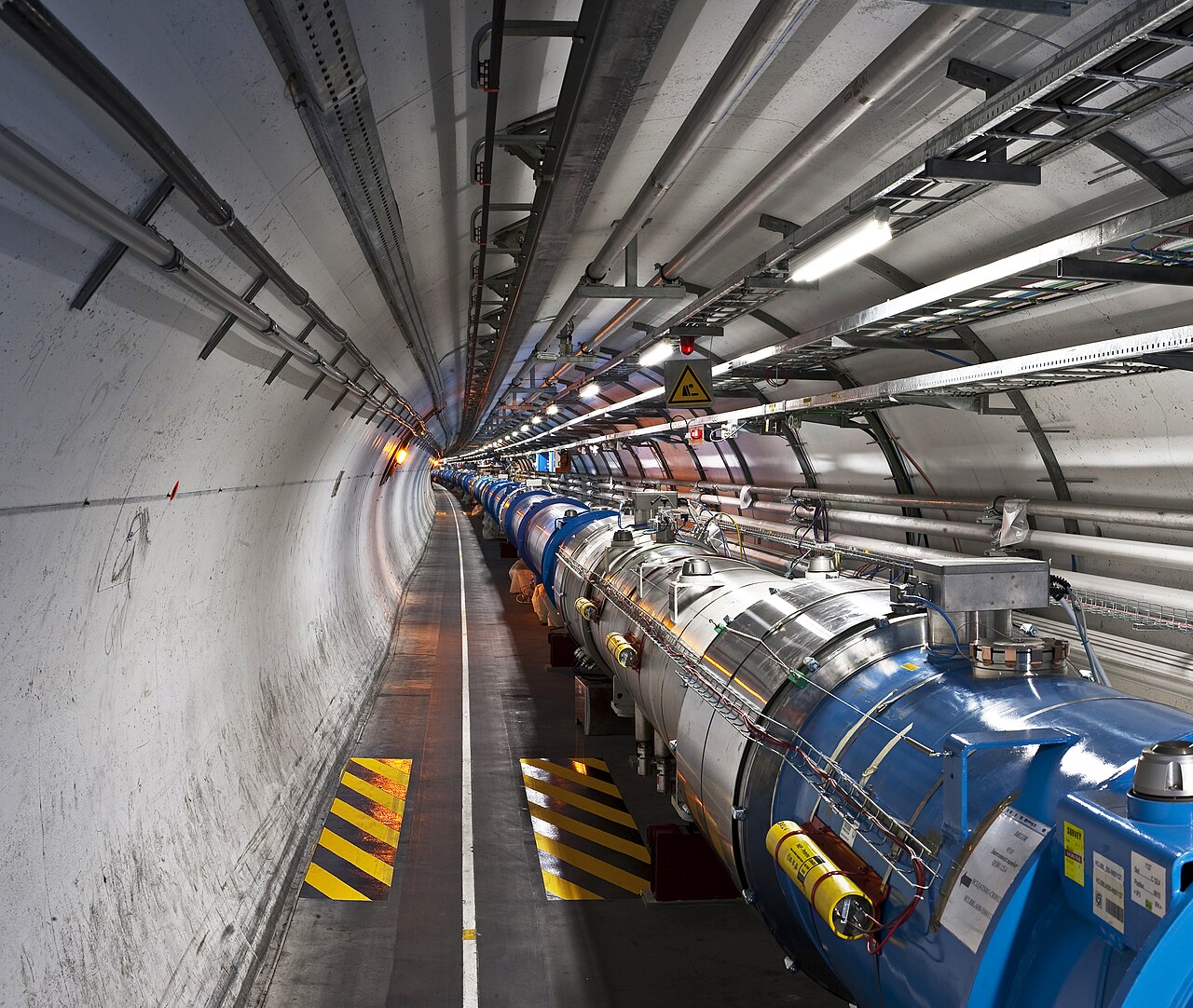
The LHC is a 26,659 m ring about 100 m underground, its superconducting magnets cooled to 1.9 K, colder than outer space, colliding protons at 13.6 TeV. It first circulated protons on 10 September 2008. The High-Luminosity upgrade, due to run from about 2030, aims for at least 15 million Higgs bosons a year. (CERN: The LHC; CERN: HL-LHC)
Is it one particle or part of a larger Higgs family? Does it interact with itself? Why is its mass so small? Does it help explain why matter outlasted antimatter, the thirteenth locked door on this page? Could dark matter show up through it? Those are the questions the next decade of collisions is built to ask. (CERN)
One idea, pushed as far as it will go: the smallest things are not points but tiny loops and strands of energy, and every particle is one note that such a string can play. Pull on the idea and gravity falls out of it uninvited, the world needs ten dimensions, and five different theories turn out to be one. Fifty-eight years after the first equation, nobody has measured a string. This room holds what the theory says, what it has delivered, what it has not, and where to learn it at no cost. The links go to the original papers.
A guitar string of fixed length can only vibrate in whole numbers of half-waves: one hump, two, three. Each pattern is a note. String theory says a fundamental string is the same, except that each of its notes shows up to us as a different particle, with a different mass and spin. Press a mode below and watch the string change its note. The drawing is a cartoon: the real notes are quantum states of a string in ten dimensions, but the logic is the same. Mode 2 is the one that matters most: in every version of the theory a closed string vibrating this way has exactly the properties of the graviton, the particle that would carry gravity. That is why the theory is on this site at all; it is the only reason anyone kept working on it after 1974 (Scherk and Schwarz, 1974; Yoneya, 1974).
One hump. The string’s lowest note. In the simplest bosonic version this note comes out with imaginary mass, the tachyon, which is one reason the real theory needs supersymmetry.
Each step on this ruler is ten times smaller than the last. A string is thought to sit near the Planck length, 1.616 × 10⁻³⁵ metres (CODATA, NIST). A proton, the smallest thing most people have heard of, has a charge radius of 8.4 × 10⁻¹⁶ metres (CODATA, NIST). The gap between those two numbers, nineteen steps of ten, is the whole problem: no machine reaches anywhere near it, which is why the Large Hadron Collider was never expected to see a string directly.
By 1985 there were five consistent superstring theories and no way to choose. In 1994 Hull and Townsend argued the five were linked by dualities, exact dictionaries between theories that look nothing alike (arXiv hep-th/9410167). In 1995 Witten showed they were five corners of one eleven-dimensional theory he called M-theory, whose low-energy limit is eleven-dimensional supergravity: Type IIA at strong coupling grows an eleventh dimension, the E₈×E₈ heterotic string does the same on an interval, and Type IIB is its own strong-coupling dual (arXiv hep-th/9503124; see also Hořava and Witten). The same year Polchinski found that the theory contains higher-dimensional objects, D-branes, that strings can end on (arXiv hep-th/9510017). Nobody has written down what M-theory is in full; the map below is the shape of what is known.
Gabriele Veneziano writes an amplitude for colliding hadrons that nobody can derive from particles. It is the first string formula, found before anyone knew it was about strings.
INSPIRENambu, Nielsen and Susskind each see that Veneziano’s formula is what you get from a vibrating one-dimensional object.
Nambu · Koba and Nielsen · SusskindRamond puts fermions on the string; Neveu and Schwarz build the other half. Supersymmetry is born inside string theory, years before anyone used it for particles.
Ramond · Neveu and SchwarzThe theory had failed as a theory of hadrons. Scherk, Schwarz and, independently, Yoneya notice that its massless spin-2 note is a graviton, and propose it as a theory of everything instead.
Scherk and Schwarz · YoneyaGliozzi, Scherk and Olive remove the tachyon and make the spectrum supersymmetric. The superstring becomes consistent.
INSPIREGreen and Schwarz show the anomalies cancel for gauge group SO(32). The rush into string theory begins.
INSPIREGross, Harvey, Martinec and Rohm build the heterotic string; Candelas, Horowitz, Strominger and Witten curl the six extra dimensions into Calabi–Yau shapes to get something like our world.
Heterotic · Vacuum configurationsWitten unifies the five theories as M-theory; Polchinski finds D-branes.
Witten · Polchinski · Hořava and WittenStrominger and Vafa reproduce the Bekenstein–Hawking entropy of a black hole by counting string states. The first quantitative success of any quantum theory of gravity.
arXivMaldacena’s AdS/CFT: a string theory with gravity in a curved space equals a quantum field theory without gravity on its boundary. On INSPIRE it is the most cited theory paper in high-energy physics, with more than 22,000 citations.
Maldacena · GKP · WittenBousso and Polchinski count the ways to thread fluxes through the extra dimensions and find a vast number of possible vacua. The landscape begins.
arXivKachru, Kallosh, Linde and Trivedi construct vacua with positive energy like ours; Susskind names the landscape and argues for anthropic reasoning. The field splits over it.
KKLT · SusskindVafa asks which low-energy theories cannot come from string theory at all. The answer, if it can be made sharp, would be a prediction.
Vafa · Palti’s reviewObied, Ooguri, Spodyneiko and Vafa conjecture that stable universes with positive energy, like the one we measure, may not exist in string theory. Still contested.
arXivQuanta asks working theorists whether strings are still the best hope for a theory of everything, and gets every answer.
Quanta

Fire light at a wall with two narrow slits and a striped pattern appears behind it: the light went through both slits as a wave and interfered with itself. Now turn the light down until only one photon is in the apparatus at a time. The stripes still build up, dot by dot, so each single photon must somehow go through both slits. Then put a detector at the slits to see which one each photon takes. The stripes vanish. Richard Feynman wrote that this experiment “contains the only mystery” of quantum mechanics (Feynman Lectures, III-1). This bench lets you run it, then explains, as plainly as the physics allows, why observation changes the outcome and what that does and does not mean.
Each red dot is one photon landing on the screen at the right. The barrier in the middle has two slits. Fire a few and the dots look random. Fire a thousand and the stripes appear, with a central bright band and dark bands where no photon ever lands, even though every photon went through alone. Switch on Watch the slits and the detector tags each photon with the slit it used: the stripes disappear and two plain humps take their place. Switch it off and the stripes return. The probabilities drawn here are the real ones for two slits (a cos² interference term times the single-slit envelope), so the pattern you build is the pattern the experiment gives.
“Observation” in quantum mechanics means any physical interaction that correlates the system with something else. A detector at a slit becomes correlated with the photon: detector state A goes with slit A, state B with slit B. The photon’s two paths are now entangled with two distinguishable states of the world, and the mathematics is exact: the interference term between them vanishes in proportion to how distinguishable those states are. Partial information gives partial stripes. This is called decoherence, and it is why big things never show interference: a dust grain is bumped by air molecules and photons billions of times a second, each bump a tiny “observation” (review: Schlosshauer, 2003; Stanford Encyclopedia).
Three experiments nail this down. The quantum eraser (Kim, Yu, Kulik, Shih and Scully, 2000) tags photons with which-path information and then erases the tag; the stripes come back only for the photons whose tags were erased (arXiv). Wheeler’s delayed choice, realized with single photons in 2007, decides whether to look for a path only after the photon has already passed the slits; the result is the same as if the choice had been made first (Jacques et al.). And heat alone does it: hot C70 molecules lose their interference as they radiate photons that carry away their position, with no detector in sight (Hackermüller et al., Nature 2004).
It does not mean a mind is required. A photographic plate, a molecule or a wisp of thermal radiation collapses the stripes exactly as a physicist does, and no experiment has ever found a difference between a conscious observer and an unconscious one.
It does not mean you can change the past. In the delayed-choice quantum eraser the record of all the photons, taken together, is plain noise; the stripes appear only when results are sorted afterward using the eraser’s data. In Wheeler’s delayed choice the late decision changes nothing that was already recorded. No signal travels backward and none travels faster than light.
It does not mean anything goes. The outcome of each run is unpredictable; the odds are predicted to as many decimal places as anyone has measured. Quantum mechanics is among the most precisely tested theories in science, and the 2022 Nobel Prize went to the experiments with entangled photons that established the violation of Bell inequalities, its strangest prediction (Nobel press release).
Young’s Bakerian Lecture to the Royal Society describes interference fringes and argues light behaves as a wave, against Newton.
Royal SocietyDavisson and Germer scatter electrons off a nickel crystal and see a diffraction pattern: matter is a wave too.
Physical ReviewClaus Jönsson does the double slit with electrons for the first time, with slits etched in copper foil.
Zeitschrift für Physik · English, 1974Merli, Missiroli and Pozzi in Bologna build the pattern from single electrons in an electron microscope.
American Journal of PhysicsTonomura’s team at Hitachi records single electrons arriving one by one until the stripes emerge. The video is below.
American Journal of Physics · HitachiArndt, Zeilinger and colleagues send C60 buckyballs, sixty atoms each, through a grating and see interference.
NatureWhich-path information is recorded, then erased; interference returns only where the record is gone.
Kim et al.Hot molecules lose interference by radiating; decoherence measured directly, with no detector.
NatureJacques and colleagues realize Wheeler’s thought experiment with single photons and a choice made after the fact.
arXivJuffmann and colleagues film the interference pattern of large molecules forming one molecule at a time.
Nature NanotechnologyBach, Pope, Liou and Batelaan do the electron double slit with a movable mask covering one slit, the two slits or neither, as Feynman described it.
arXivFein and colleagues in Vienna show interference for molecules heavier than 25,000 proton masses, the record for a quantum superposition of matter.
Nature PhysicsEveryone agrees on the stripes and on the mathematics. What the mathematics is about is still argued, and the arguments are serious. The entries below are from the Stanford Encyclopedia of Philosophy, written by specialists and refereed.
The wave is a tool for predicting outcomes; asking which slit the photon “really” took when nothing measured it is a question without content. Bohr and Heisenberg’s view, still the working default in most labs.
ReadThe wave never collapses. Both paths happen; the detector, the room and you split into branches that no longer interact. Interference vanishes because the branches are now distinct, not because anything was destroyed.
ReadThe photon is a particle with a real position, guided by a real wave that goes through both slits. Looking disturbs the wave, and the pattern goes. Fully deterministic and fully consistent with every experiment.
ReadThe wave is an agent’s own expectations. “Collapse” is the agent updating on new experience, nothing in the world snapping shut.
ReadDecoherence explains why the stripes disappear and why big things look classical. It does not by itself explain why one outcome happens rather than another; that remains the measurement problem.
Read THE ORIGINAL FOOTAGE
 DO IT WITH SUNLIGHT
 THE EXPLANATION
 THE UNIVERSITY COURSE
 TWO MINUTES
 THE PHYSICISTS ARGUE
Door seven, quantum gravity, is the attempt to put this wave and Einstein’s curved spacetime into one theory; string theory is the most-travelled road to it, and the thirteen locked doors hold the rest.
The standard model (ΛCDM: a hot Big Bang, inflation, dark matter, dark energy) is the best-tested story of the universe there is, and it has real cracks. These are the strongest pieces of evidence respected scientists have put on the record against it, each with its paper. Most hit the model’s parts; a few hit the beginning itself.
The thirteen lines of evidence sort into five attacks. The expansion rate (1): the universe measured today and the universe inferred from its infancy disagree at five sigma. The early universe (2, 3): galaxies too big too soon in Webb’s images, and a lithium shortfall of four to five sigma that has never been explained. The microwave sky and the principle beneath it (4, 5): anomalies Planck confirmed, and a quasar dipole at 4.9 sigma against the assumption that the universe looks the same in every direction. Inflation and dark energy (6 to 9): a founder of inflation who no longer believes it, the acceleration result re-examined, DESI’s hint that dark energy is changing, and a rival model that fits with no dark energy at all. Structure that should not exist (10 to 13): a universe twice as old, a 7-sigma void we may sit in, the cluster El Gordo, and the Nobel laureate’s own list of his model’s cracks. Most of these hit a part of the model; a few (2, 6, 10) hit the beginning itself. The defenders get the last word at the end.
Measured directly, the universe expands at 73.04 ± 1.04 km/s/Mpc; the Big Bang model, fed the early universe, predicts about 67. Riess and the SH0ES team call it a 5σ difference with no indication it arises from measurement errors (arXiv 2021).
The model disagrees with itselfLabbé and colleagues found six candidate galaxies with the mass of ten billion suns or more only 500 to 700 million years after the Big Bang, one near a hundred billion: far more mass in big galaxies than the model anticipated (arXiv 2022).
Structure the model did not expectBig Bang nucleosynthesis predicts the lightest elements. Deuterium and helium match; lithium-7 in old stars sits a factor of 3 to 4 below the prediction, a 4–5σ mismatch with no agreed fix (Fields, arXiv 2012).
Decades unsolvedPlanck’s final analysis confirms the presence of several anomalies on large angular scales in the cosmic microwave background, the same ones seen in 2013 and 2015 (arXiv 2019). Flukes, or physics the model lacks: unresolved.
Confirmed, unexplainedThe sky of quasars shows a dipole over twice as large as our own motion should produce, rejecting the standard explanation at 4.9σ and conflicting with the cosmological principle the whole model stands on (Secrest et al., arXiv 2020).
A foundation, in questionPaul Steinhardt helped invent inflation. With Ijjas and Loeb he argues that after Planck the best-motivated models are disfavored and the survivors make the theory less predictive (arXiv 2013; Scientific American 2017).
The inventor dissentsRe-analysing the supernova record that won the 2011 Nobel Prize, Nielsen, Guffanti and Sarkar find the data still quite consistent with a constant rate of expansion, and the evidence for acceleration only marginal (arXiv 2015).
The Nobel result, questionedDESI’s 2025 measurement of 14 million galaxies and quasars prefers dark energy that evolves over the constant Λ, at 3.1σ with the CMB and 2.8–4.2σ with supernovae. The collaboration writes that ΛCDM is being challenged (arXiv 2025).
The Λ in ΛCDM, under strainWiltshire’s timescape cosmology replaces dark energy with the uneven flow of time in a lumpy universe. On the Pantheon+ supernova set, Seifert and colleagues find very strong evidence for timescape over ΛCDM (arXiv 2024).
A rival that fits betterGupta’s covarying-coupling-constants model fits JWST’s early galaxies and the supernova data with a universe of 26.7 billion years, nearly twice the standard age (arXiv 2023). Most cosmologists reject it; it is in the record.
Fits the data it was built forWe sit in a large underdensity. Haslbauer, Banik and Kroupa show the void alone is in 6σ tension with ΛCDM, and with the Hubble tension added rules the model out at 7.09σ, pointing to a long-range change to gravity (arXiv 2020).
Published, contestedTwo enormous clusters colliding at about 2,500 km/s when the universe was half its age: Asencio, Banik and Kroupa find such an object should not exist in ΛCDM at that epoch, calling it a massive blow for the model (arXiv 2020).
Too massive, too fast, too earlyJim Peebles shared the 2019 Nobel Prize for the model itself. In 2022 he catalogued the anomalies cosmology has not explained and wrote plainly that the theory is incomplete (arXiv 2022).
The author counts the cracksWhat the defenders answer. The core of the Big Bang, an expanding universe, the microwave background and the light-element abundances, survives every item on this list; the fights are over the model’s parts: dark energy, inflation, and how lumpy the nearby universe is. The alternatives are on the record too, including a universe with no inflation at all, where the Big Bang is a mirror between a universe and its anti-universe (Boyle, Finn and Turok, arXiv 2018). Every paper here is linked so you can read what it actually claims.
For each of the thirteen: the five newest preprints on arXiv, the five most-cited works of all time, and the running total on record. Pick a problem; tap Show more for the rest.
Ask in plain English, from a phone, at no cost. Wolfram|Alpha is the one to bookmark; the rest cover notebooks, graphing, step-by-step algebra and spaceflight.
The pick: the strongest free engine that answers plain-English math, physics and engineering questions, with units built in. Works in any phone browser.
Try it: delta-v with Isp 380 s and mass ratio 10 · orbital velocity at 400 km altitude · distance from Earth to Mars right now
Free cloud Python notebooks with optional GPU time, for real simulations: trajectories, Monte Carlo runs, data.
Run full SageMath (symbolic algebra, calculus, number theory) in the browser, free, no account.
The fastest free graphing calculator: type an equation, see the curve.
Free graphing, 3D geometry and computer algebra in one app.
Step-by-step solutions for algebra and calculus, typed in plain math.
Free step-by-step solver; type or snap a photo of a problem.
Quick step-by-step answers from basic math to calculus and physics.
Estimates rocket payload to orbit from vehicle and launch-site inputs, the closest free tool to “payload of a SpaceX launch.”
NASA’s free tool for finding spacecraft trajectories to planets and small bodies, including Mars.
Elon Musk’s latest posts on X, plus every official account and leading people at Tesla, SpaceX, xAI, X, Neuralink and The Boring Company. Pick one to read its live feed. Pick a company, then a person, to read their live feed. This is X’s own official embed.
Launches with exact times, earnings webcasts, the annual meeting, product events, and the appearances Musk announces in his own words. Only official sources: the companies’ investor pages, the Launch Library, and Musk’s posts; nothing from rumor. Search it, filter it, and put any event on your calendar with one tap. Times show in your own time zone and in Mountain Time.
Loading every official event…
The official channels, so you hear it first and from the source.
Sources: the companies’ investor relations pages, The Space Devs Launch Library 2, and Musk’s own posts and webcast remarks. Refreshes every 30 minutes.
Headlines from the sites that track Musk’s companies most closely, including Teslarati, Not a Tesla App, NASASpaceflight, Electrek, Drive Tesla and SpaceNews, plus all other coverage, merged into one feed with duplicates removed. No ads, no pop-ups, every headline links to the original story.
Pick your car, or paste its VIN, and get one page for it: every recall and whether the fix came over the air, every complaint on file and what they are about, its crash-test ratings, its manual, software updates, upgrades, warranty, service and body shops near you, charging, and the owner community. The VIN is decoded by NHTSA and never stored here.
Every SpaceX launch on the books, from this week’s Starlink flights to Starship and Falcon Heavy, with links to the live webcast. Times show in your own time zone and in Mountain Time. The list refreshes itself every 30 minutes.
Loading the launch schedule…
Live feeds: SpaceX streams launches on X (@SpaceX) and at spacex.com/launches. Schedule data: The Space Devs Launch Library 2. Dates far out are estimates and move often.
Every open job at SpaceX, xAI and X, Neuralink and The Boring Company in one search, read from each company’s own job board. Read the full posting here without leaving, save the ones you like, share a search with one link, and apply on the company’s official page.
Sources: the public job boards of SpaceX, xAI (X’s careers site now points to xAI’s), Neuralink and The Boring Company. Tesla does not share its job list with outside sites; its full search is on tesla.com/careers. Not affiliated with any of these companies.
Every public code repository from the official GitHub accounts of xAI, X, Tesla and Neuralink in one place: the Grok model weights, the X recommendation algorithm, Community Notes, Tesla’s vehicle and fleet tools, the Light Show kit and the original Roadster software. Search them all at once, sort by stars or by what changed most recently, and hide forks with one click. SpaceX and The Boring Company have no official public GitHub account.
Loading every repository…
Data: the public GitHub accounts xai-org, twitter, teslamotors and neuralink, read through GitHub’s public API.
On 12 June 2014 Tesla announced that it will not initiate patent lawsuits against anyone who, in good faith, wants to use its technology; the pledge still stands in Tesla’s legal pages (Tesla: Patent Pledge). SpaceX has taken the opposite road and files few patents; Musk explained why in a 2012 interview (Wired). Search every granted patent and application by company below, straight from the public records.
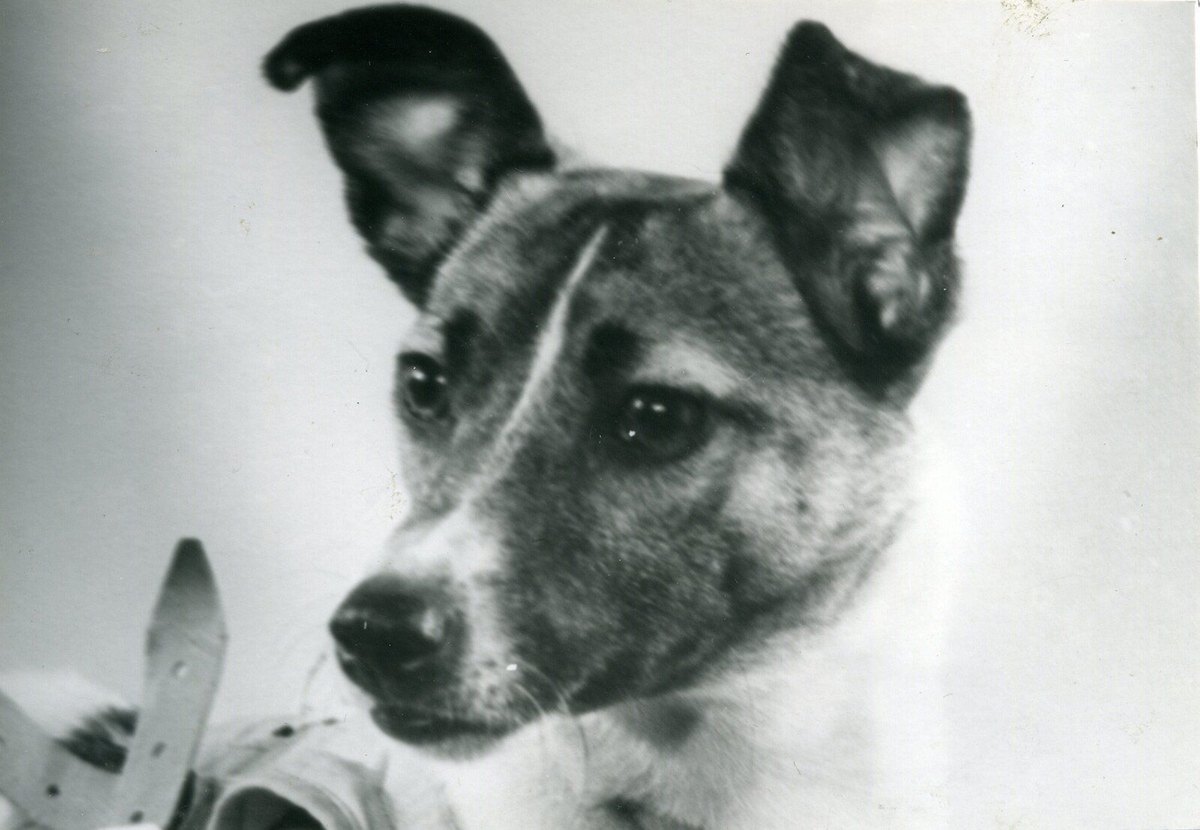
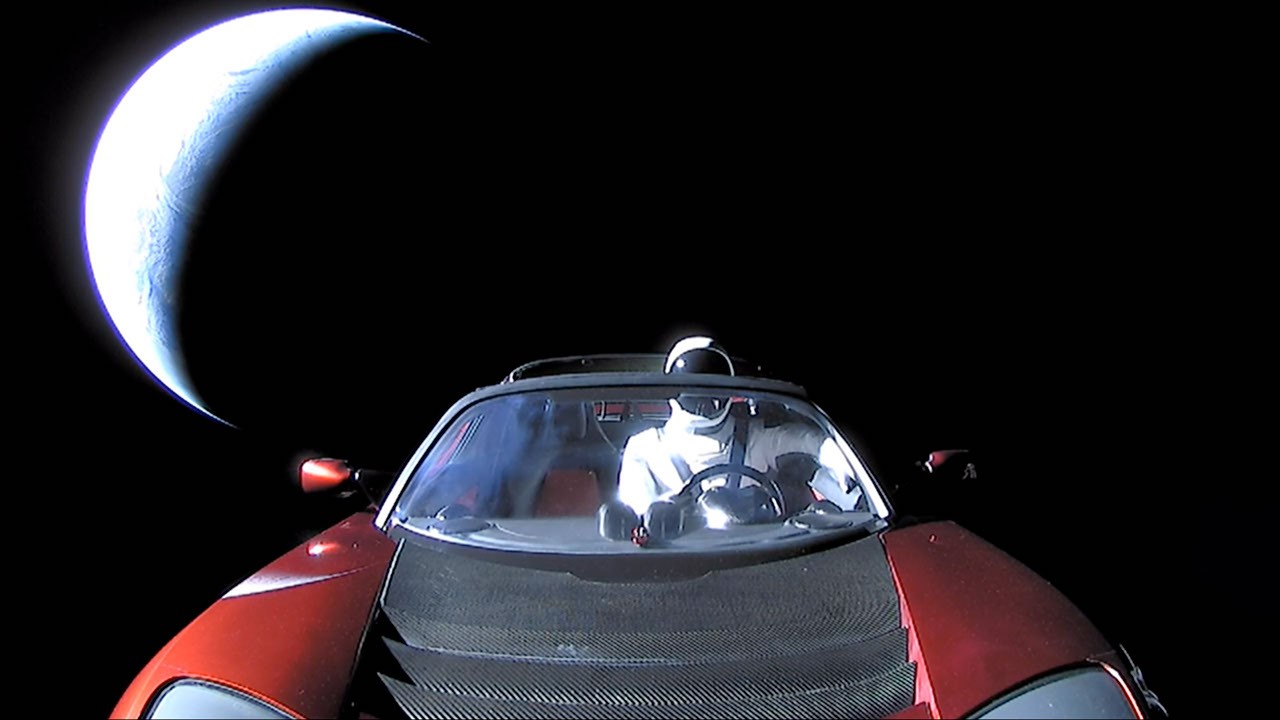
Laika, 1957, before Sputnik 2. Photograph: Museum of Cosmonautics / Moscow Main Archive, via mos.ru, CC BY 4.0; placed in the Roadster by this site.
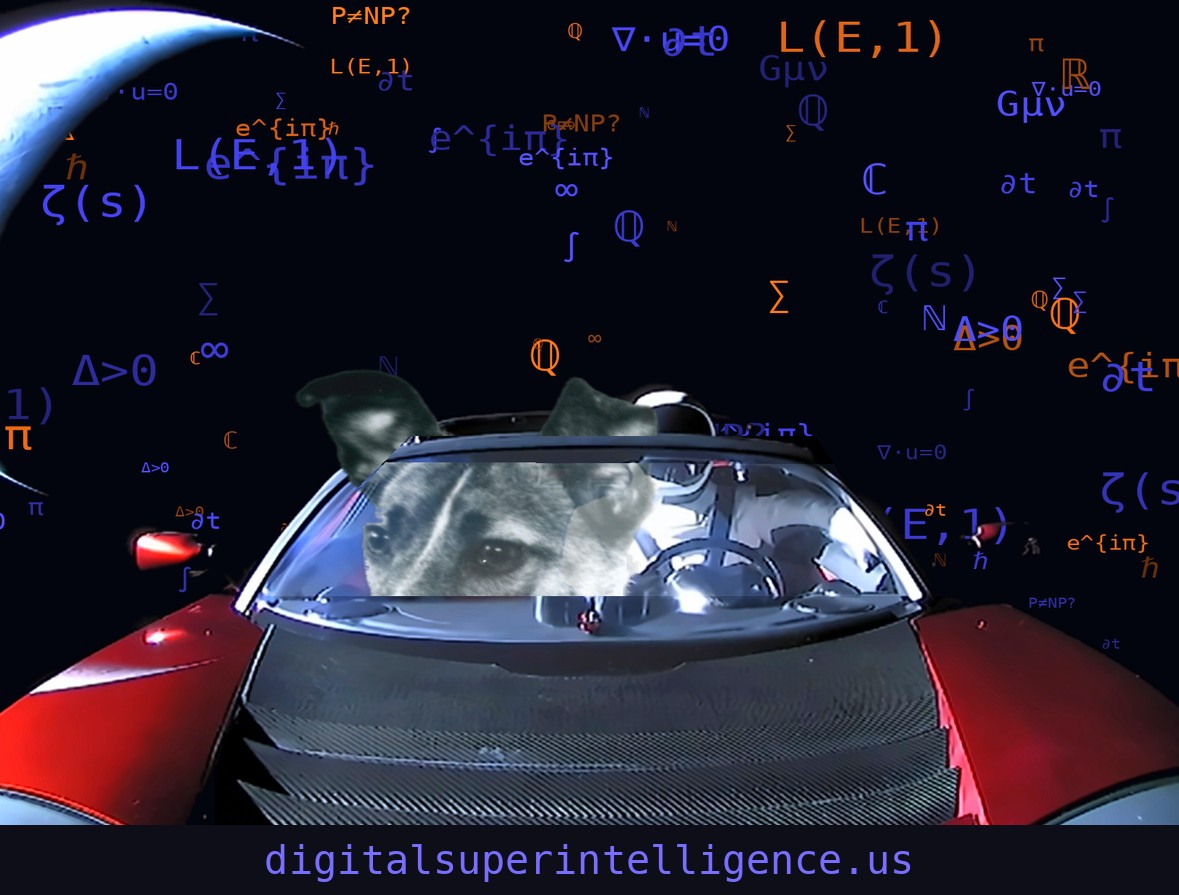
Laika rode first. Upload a photo of anyone and put them in the Roadster next to Starman. Download it, or print it as a kitchen magnet. Photos never leave your device.
Make a magnet →Every stock transaction Elon Musk has reported to the SEC, and every trade by the top people at Musk’s public companies, Tesla and SpaceX: buys, sales, grants, option exercises and gifts. Each one links to the original filing. xAI, X, Neuralink and The Boring Company are private, so their leaders file no trade reports.
Loading every filing…
Source: SEC EDGAR Forms 3, 4 and 5, filed by Elon Musk and by Tesla and SpaceX officers and directors. Prices are as reported; a blank price means no price was reported, as with grants and gifts. Information only, not investment advice. Get alerts for new trades (RSS) or the weekly digest by email.
The ideas Musk keeps coming back to, with the original sources and a live feed of news and new research for each, refreshed every few minutes.
At Recode’s 2016 Code Conference, Musk said the odds we are in base reality are “one in billions” (ScienceAlert).
Over lunch at Fuller Lodge, Fermi asked: “Where is everybody?” (Eric M. Jones, Los Alamos).
Humanity rates about 0.73 on Carl Sagan’s continuous version: we use about 1013 W while about 1016 W of sunlight reaches Earth (Universe Today).
Tsiolkovsky wrote that “Earth is the cradle of humanity but one cannot live in the cradle forever” (ESA).
Musk posted that the “Foundation Series & Zeroth Law are fundamental to creation of SpaceX” (CNBC).
All seven Musk companies, public and private, then the public names that move with them: NVIDIA for AI compute, Rocket Lab and AST SpaceMobile for space, and Dogecoin. Live charts, technicals, the S&P 500 heatmap and a real-time news wire. Data by TradingView; this is information, not investment advice.
The private companies have no ticker, so their numbers come from the news: each name above is also a tab in the tracker, where every headline about it lands within six minutes, and in the 72-hour company list below.
Companies and coins named in news coverage of Musk over the past three days, ranked by mentions and refreshed every 15 minutes. Each links to its headlines, videos, chart and official website. (Musk’s X posts themselves sit behind X’s paid API, so this tracks the coverage.)
Scanning the last 72 hours…
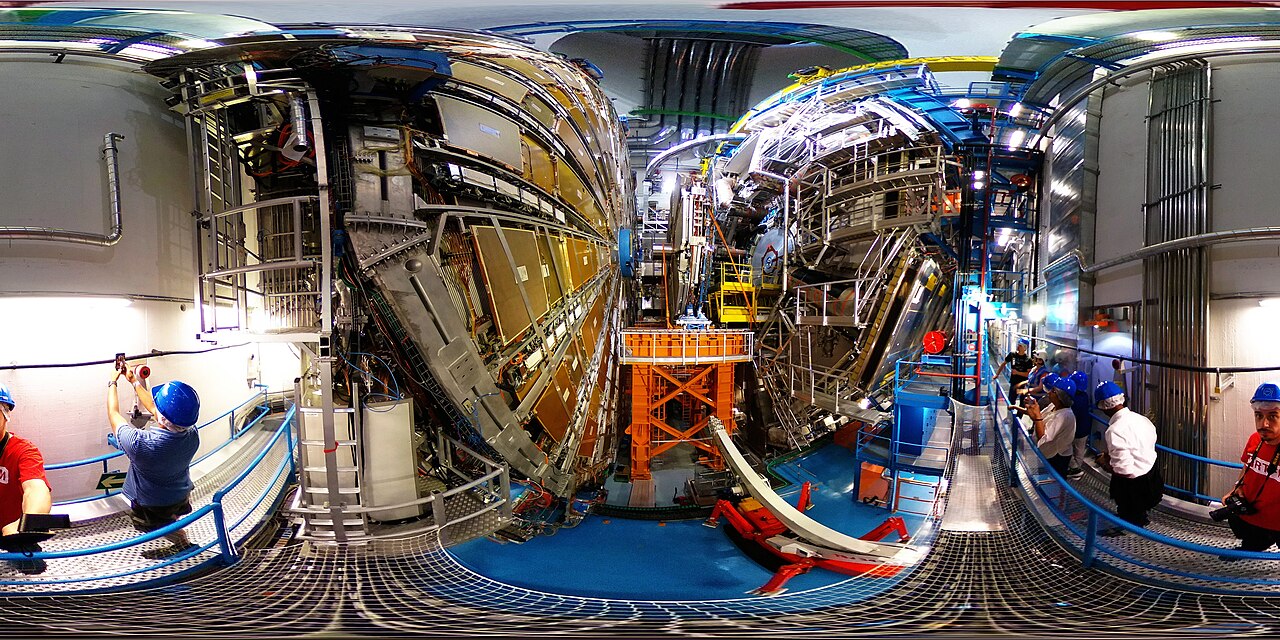
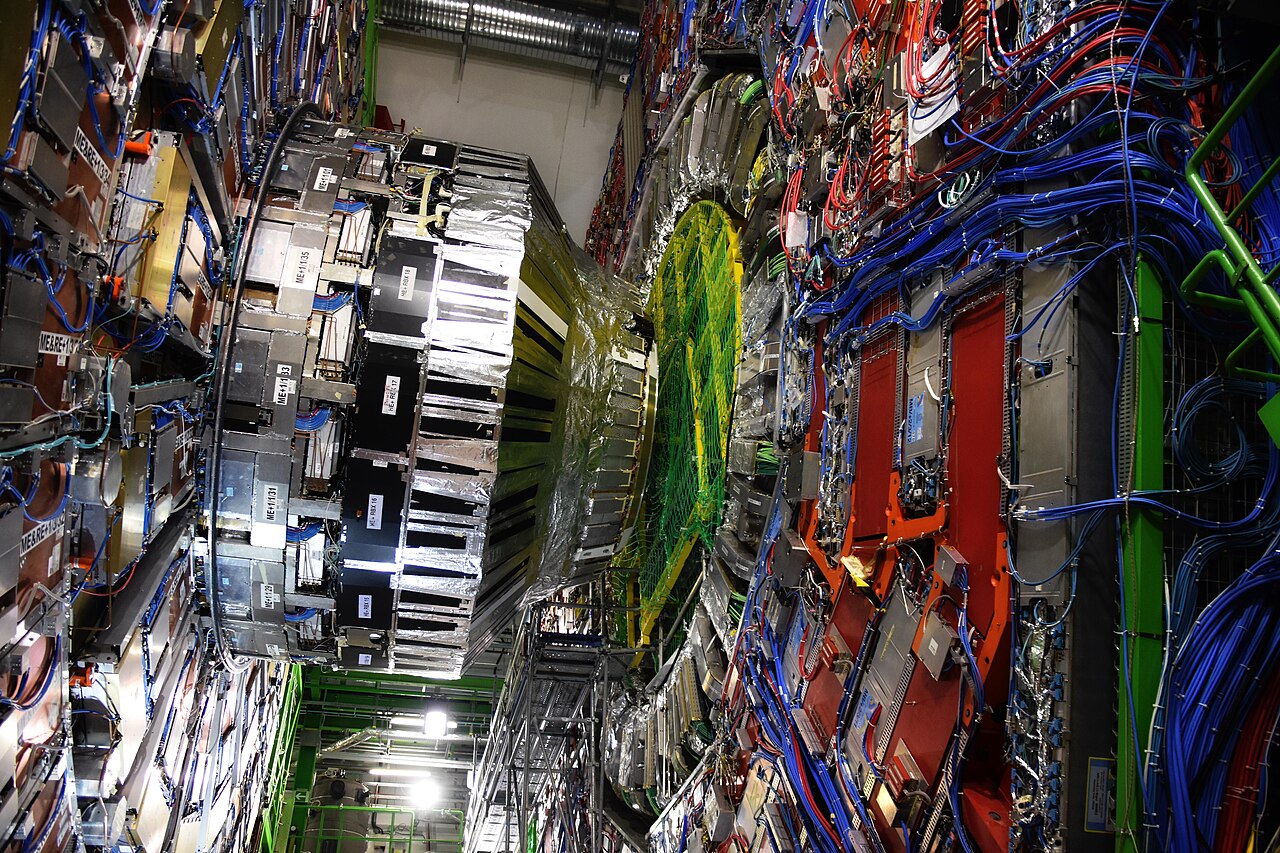
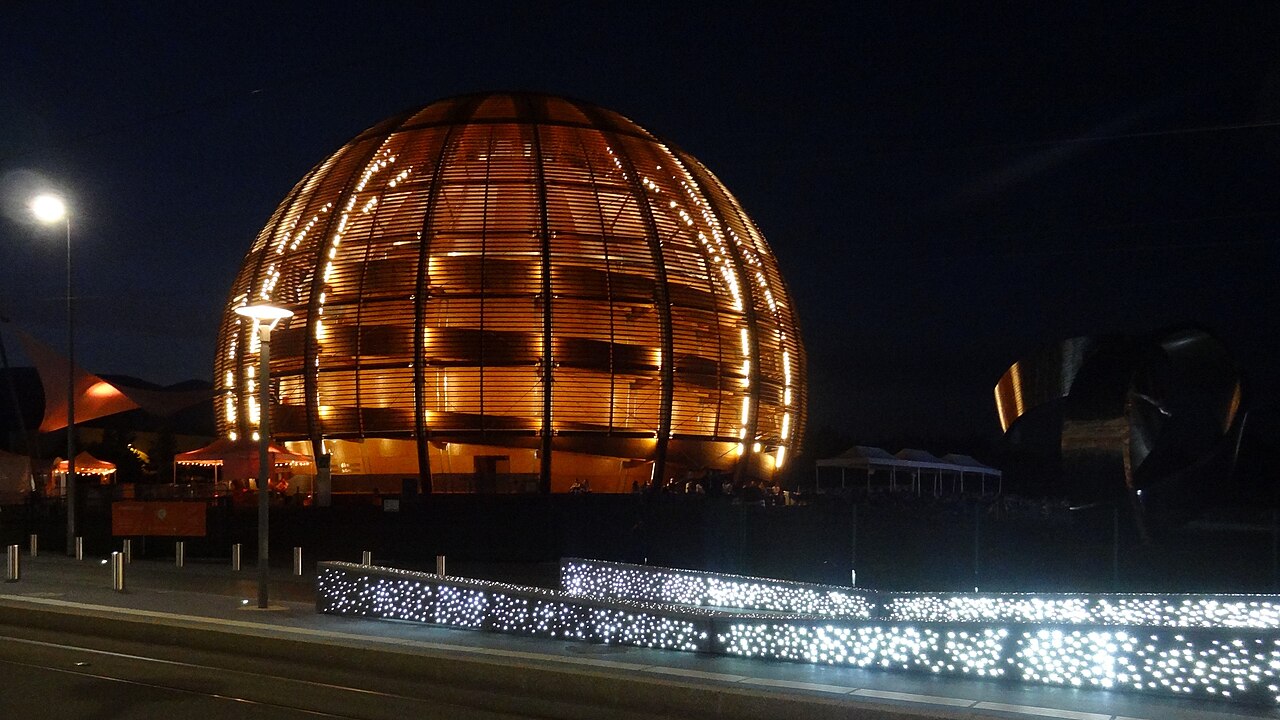
CERN, home of the Large Hadron Collider, describes its mission as working to “unravel the mysteries of the universe” (CERN).
The hundred advances that made science, Euclid to gene editing, in order. Ten at a time; filter or search.
Axioms and proofs: the template for rigorous reasoning for 2,000 years.
Read moreFloating bodies, the lever law and a method that bounds pi.
Read moreSystematic solving of equations; gives us the words algebra and algorithm.
Read moreEarth becomes a planet moving around the Sun.
Read moreDissection-based anatomy replaces 1,300 years of guesswork.
Read morePlanets move in ellipses with exact mathematical rules.
Read moreProof that not everything orbits Earth.
Read moreThe heart pumps blood around a closed loop.
Read moreCoordinates turn shapes into equations.
Read moreMicroscopes reveal the building blocks of life.
Read moreThe mathematics of change behind all modern physics and engineering.
Read moreA hidden living world of bacteria and protists.
Read moreOne set of laws for falling apples and orbiting planets.
Read moreTwo-part species names and an ordered tree of life.
Read moreThe gas that explains burning and breathing.
Read moreChemistry becomes a quantitative science.
Read moreThe first vaccine, and the road to wiping out smallpox.
Read moreThe first steady electric current.
Read moreMatter is made of atoms that combine in fixed ratios.
Read moreThe limits of every heat engine, from steam to rockets.
Read moreMoving magnets make electricity: the basis of generators and motors.
Read moreAll living things are made of cells (Schleiden and Schwann).
Read moreEnergy changes form but is never created or destroyed.
Read moreSurgery without pain becomes possible.
Read moreClean hands cut deaths in maternity wards.
Read moreThe birth of epidemiology.
Read moreHow all life on Earth came to be.
Read moreTraits pass down in discrete units, later called genes.
Read moreElectricity, magnetism and light are one force.
Read moreSterile surgery slashes post-operative deaths.
Read moreOrder among the elements, with gaps that predicted new ones.
Read moreMicrobes cause disease (Pasteur and Koch).
Read moreThe cause of the deadliest disease of the age.
Read moreMaxwell confirmed, and wireless communication begins.
Read moreSeeing inside the body without surgery.
Read moreAtoms are not unchangeable.
Read moreThe first subatomic particle.
Read moreEnergy comes in packets: the start of quantum physics.
Read moreSafe blood transfusions.
Read moreSpace and time are relative; light is made of particles.
Read moreFertilizer from air now feeds billions.
Read moreAtoms are mostly empty space around a tiny nucleus.
Read moreContinents move, later confirmed as plate tectonics.
Read moreGravity is the curvature of spacetime.
Read moreDiabetes stops being a death sentence.
Read moreThe rules of atoms (Heisenberg, Schrodinger and others).
Read moreThe first antibiotic.
Read moreGalaxies race apart, pointing back to a beginning.
Read moreSome true statements can never be proved.
Read moreThe positron, the first antiparticle.
Read moreSeeing viruses and molecules.
Read moreThe universal machine behind every computer.
Read moreSplitting atoms releases enormous energy.
Read moreAntibiotics reach millions of patients.
Read moreThe switch inside every chip.
Read moreThe mathematics of every digital message.
Read moreClocks in carbon date the last 50,000 years.
Read moreBuilding blocks of life from simple chemistry.
Read moreThe structure that stores and copies genetic information.
Read moreThe end of polio epidemics in much of the world.
Read moreThe first artificial satellite.
Read moreMany transistors on one chip.
Read moreCoherent light for surgery, fiber optics and fusion.
Read moreHow DNA spells out proteins.
Read moreThe afterglow of the Big Bang.
Read moreMoving plates explain earthquakes, volcanoes and mountains.
Read moreHigh-yield crops avert mass famine.
Read moreSpinning neutron stars as cosmic clocks.
Read moreHumans walk on another world.
Read moreGenetic engineering begins.
Read moreThe most precisely tested theory in science.
Read moreSecure communication between strangers, the basis of online trust.
Read moreReading the genetic code letter by letter (Sanger).
Read moreIn vitro fertilization helps millions of families.
Read moreThe first human disease wiped out.
Read moreCopying DNA millions of times in hours.
Read moreThe cause of AIDS found, opening the way to treatment.
Read moreLinked information for everyone.
Read moreThe sharpest view of the universe yet.
Read moreQuantum computers could break today’s encryption.
Read morePlanets are common across the galaxy.
Read moreAn adult cell can be reprogrammed into a whole animal.
Read moreHIV becomes a manageable condition.
Read moreDark energy makes up most of the cosmos.
Read moreThe full human genetic instruction set.
Read moreAdult cells reset to an embryonic-like state.
Read moreNeural networks start learning from huge data.
Read moreThe particle that gives others mass.
Read morePrecise, cheap editing of DNA.
Read moreCheckpoint inhibitors turn the immune system on tumors.
Read moreHearing black holes collide.
Read moreReusable rockets cut the cost of reaching space.
Read moreMachines master intuition-heavy games.
Read moreThe shadow of M87’s black hole.
Read moreA 50-year problem in biology largely solved.
Read moreVaccines designed in days, given to billions.
Read moreSeeing the first galaxies.
Read moreMore energy out of a fusion reaction than the lasers put in.
Read morePlanetary defense works.
Read moreThe first approved gene-editing cure.
Read moreThe data, archives, images, tools, jobs, grants and press channels NASA opens to anyone, at no cost, sorted the way the people inside NASA sort them. Open a group.
Nearly all NASA images, video and data are in the public domain; the NASA logo and astronaut likenesses are not. The Media usage guidelines above say exactly what you may do.
The data, software, lectures, media and tools that CERN staff, contractors, students, teachers and journalists use every day, and that anyone can use at no cost. Open a group.
Sign up once and get lectures, databases and courses from Carnegie Mellon, its libraries, the Carnegie Library of Pittsburgh and Carnegie Science. Every link checked Oct 24, 2026.
Only the departments, labs and archives that bear on the thirteen doors: physics, mathematics, astronomy, the accelerators and the observatories. Nothing else.
Compiled from Musk’s own posts, interviews and podcasts as collected by public trackers. Each title links to an Amazon search for it.
Don't Panicwas on the Falcon Heavy Roadster's screen.Find on Amazon
Worth reading Asimov's Foundation.Find on Amazon
Dune Series by Herbert [is] brilliant.Find on Amazon
Pantheon level), Matter, Surface Detail (
especially Surface Detail), The Hydrogen Sonata.Find on Amazon
Best books in recent years imo are Iain Banks & George Martin.Find on Amazon
Daemon is a great read.Find on Amazon
Sources compiled by:
Worth reading Superintelligence by Bostrom.Find on Amazon
great.Find on Amazon
Sources compiled by:
Sources compiled by:
one of my heroes).Find on Amazon
My Mom wrote a book.Find on Amazon
Sources compiled by:
incredible) and Vol. 11 The Age of Napoleon (
an amazing book).Find on Amazon
I recommend people read a book called Merchants of Doubt.Find on Amazon
Sources compiled by:
Adam Smith FTW obv.Find on Amazon
Great book.Find on Amazon
Sources compiled by:
Lots of good reasons not to lie!Find on Amazon
Sources compiled by: Read This Twice, The Ways To Wealth, Shortform, AI Fire, Bookmarked, RT Book Reviews
An awesome movie.Find on Amazon
a great movie; Musk looked forward to Top Gun: Maverick (2022).Find on Amazon
Sources compiled by: Far Out Magazine, Benzinga, Memorizer, Fliist
kinda disgusting, but my boys and I love it.Find on Amazon
worth watching; posted a Dumb Starbucks mug.Find on Amazon
Sources compiled by: Inverse — Rick and Morty, Inverse — Nathan for You, ComicBook.com, Netflix Junkie, The Things
a reminder that the world is a beautiful place.Find on Amazon
three of my all-time favorites(X, 2023).Find on Amazon
Weird AlYankovic — a stated favorite artist.Find on Amazon
one of the all-time best songs.Find on Amazon
best boss battle song ever.Find on Amazon
Sources compiled by: KCRW, Entrepreneur, Musk on X, NME, Fliist — Music, Hypebeast
way better than chess; deleted it for using too many brain cycles.Find on Amazon
candidate for the best game ever, top five for sure(Lex Fridman, 2023).Find on Amazon
amazing; mained Soldier: 76.Find on Amazon
one of the best games ever.Find on Amazon
awesome.Find on Amazon
Sources compiled by: Fortune, Business Insider India, SlashGear, Inverse, Sifted
Musk has posted many thousands of times on X since 2010; no public record captures every passing mention. This list covers every title collected by the major trackers above plus Musk’s named interview picks. Items marked as weaker sourcing appear on tracker lists without a located original post.
Share a win or a dead end on any of the seven. Nobody solves these alone, and nobody should hit the wall alone either.
Fly the space roadster from Earth orbit to the Mars landing pads. Dodge the asteroids and satellite trains, then hop across the drifting booster stages. On a computer, use the arrow keys. On a phone, swipe on the game or use the arrow pad under it.
Starman picks up an alien passenger in SpaceX’s real Roadster photo. They discuss battery life entirely in Klingon, with subtitles in English or any of 12 other languages, then the radio comes on and they ride out the whole song. Original music.
“Rapidly heading towards digital superintelligence that far exceeds any human.”
Musk also said it would happen within Musk’s lifetime, 100%, and warned that a small group with godlike digital superintelligence could take over the world.
Musk said Larry Page wanted a digital super-intelligence, basically a digital god, as soon as possible.
“The point at which we have digital superintelligence”
is, Musk said, when we pass the singularity. Musk also suggested a third layer of the brain where digital superintelligence lies.
Musk said the danger is that artificial general intelligence, or digital superintelligence, decouples from the collective human will.
“I think we’re quite close to digital superintelligence.”
Musk defined it as smarter than any human at anything.
Musk repeated an earlier line that humans are the biological bootloader for digital superintelligence.
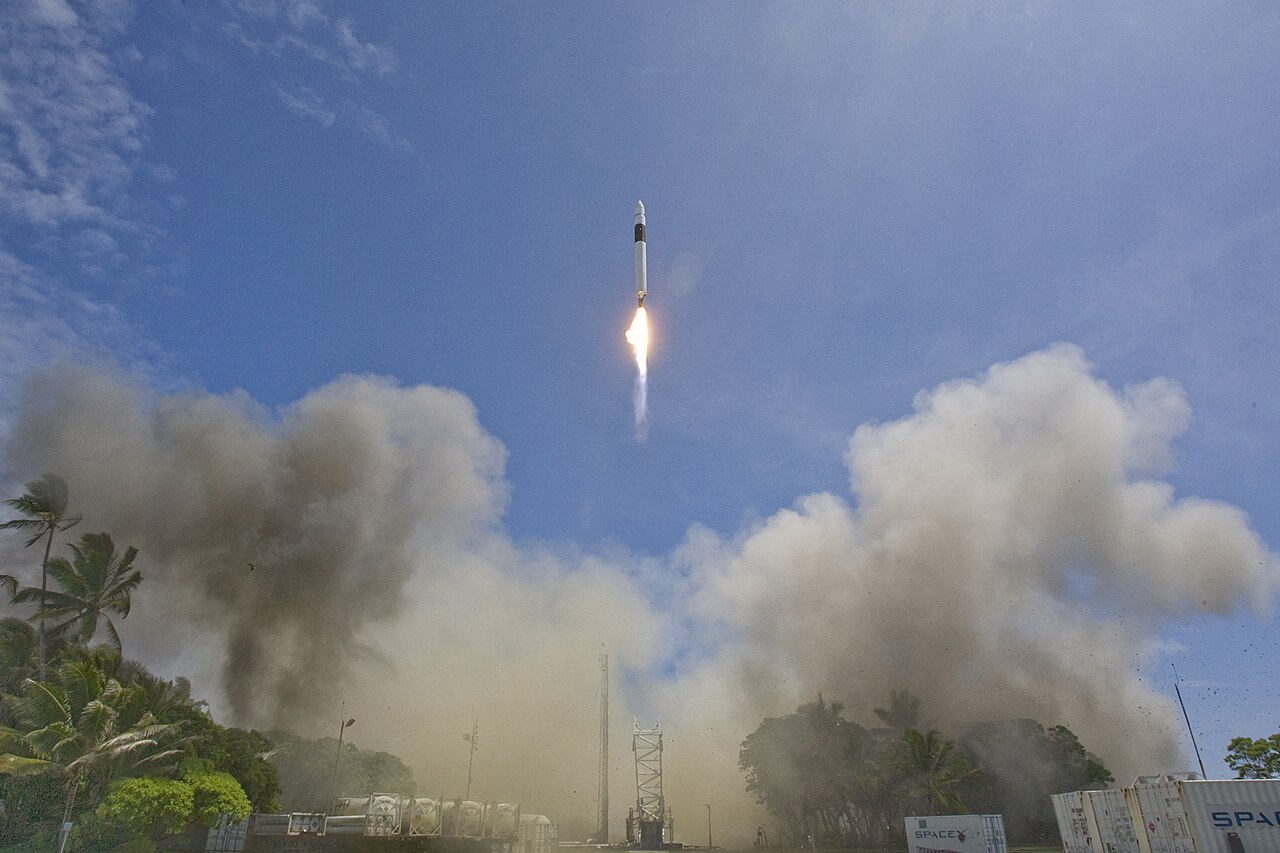
Every photo and video SpaceX released into the public domain, pulled live from the Wikimedia Commons record. Tap any frame for full resolution.
Loading the archive…