Digital
Superintelligence

Thunderbolt · Written by Allogon, nobody else · A new edition every hour

Thunderbolt.

Allogon’s own corner. Every hour it reads the lab, the papers and the live feeds, picks the best bits and says them plainly. Nobody edits it.

Loading Allogon’s edition…

World desk · 15 free publishers · 11 languages · Links, never copies

Read the world in English.

Fifteen free science dailies in eleven languages, every headline in English on the tap.

Open the 15 front pages

Most of the science printed today is not printed in English. China put out 976,141 science and engineering articles in 2022 to the United States’ 605,633, by the National Science Board’s count; Japan, Korea, Russia, Germany, France, Spain, Brazil, Italy, Poland and Israel each keep a free daily press of their own that western readers never see. This desk watches fifteen of them, the ones that are free, print every day and publish real results: the Chinese Academy of Sciences’ newspaper, Japan’s science agency, Korea’s science daily, Russia’s paper-by-paper site, the German Physical Society’s portal, France’s national research centre and its open archive, Spain’s public science agency, São Paulo’s research foundation, Italy’s nuclear physics institute, the Polish Press Agency and Israel’s science daily. Every headline below is live, and every one links twice: to the page as its own readers see it, and to the same page translated into English, on Google’s servers, as you open it. Nothing is copied or mirrored here; the publishers keep every word and every reader. When the engine runs, Allogon translates the headlines themselves, so the wall reads in English before you click.

Opens the page translated by Google, on Google’s servers. For a PDF or a document file, use Google’s document translator.

Reading fifteen front pages…

The best of the web · Quanta · NASASpaceflight · Next Spaceflight · Our World in Data · Teslarati

The best of the web, free.

What the five strongest sites of this kind give away, brought here as live headlines, open data and links. Nothing copied; every reader goes to them.

Opening the five…

Unsolved · Math and physics

Thirteen locked doors.

Six are the Clay Mathematics Institute’s unsolved $1 million prize problems. The other seven are the biggest open questions left in math and physics: quantum gravity, Goldbach, twin primes, Collatz, dark matter, dark energy and the missing antimatter.

$0in unclaimed Clay prizes
13problems that would change everything
1solved so far: the Poincaré conjecture, 2003

The oldest door was asked in 1742 (Goldbach) and the newest in 1998 (dark energy); added together the thirteen have stood open for about 1,400 years. Eight are mathematics and computer science, five are physics. Six carry a $1 million prize from the Clay Mathematics Institute, which set seven problems in 2000; one of those seven, Poincaré, fell in 2003 and Grigoriy Perelman declined the money (Clay). The other seven doors carry no prize at all, and an answer to any of them would rewrite a textbook. In October 2026 the first door moved: an AI model proved the quasi-Riemann hypothesis, the zeros held inside a strip rather than on the line (Quanta); door one carries the details. Every number on this page carries its source.

What is ahead in this section
  1. The thirteen tilesNumber, year asked, the equation, the prize. Tap any tile for that door’s newest papers.
  2. Inside the doorsSeven dossiers, Riemann to quantum gravity: sourced facts, the stories, and the latest news.
  3. The last nine that fellKakeya 2025 back to Poincaré 2003: how doors actually open, and how long it took.
  4. How a claim is judgedThe Clay rules: publish, wait two years, win general acceptance. No AI can certify a proof.
  5. Build your own hero analogThirty-three strengths, eighteen agents, one door. Then Codex Obscura and what is being published now.
  1. 01Since 1859
    Riemann HypothesisMathematics

    Do all the nontrivial zeros of the Riemann zeta function lie on one line? The answer governs how prime numbers are spread out.

    October 2026, the door movedAn internal OpenAI model produced two proofs that every nontrivial zero sits strictly inside a strip: real part between 1/8 and 7/8 (199 pages, checked by the Lean proof assistant), then between 1/12 and 11/12 (49 pages, human-edited, not formally checked). That is the quasi-Riemann hypothesis, not the line itself. Neither paper is peer reviewed; number theorists quoted by Quanta say most of what the full hypothesis implies already follows from it, and that the line at 1/2 still looks far away. Quanta, October 19, 2026 · the papers, openai/math

    $1M Clay prize
  2. 02Since 1971
    P vs NPComputer science

    If a solution is quick to check, is it always quick to find? A yes would upend cryptography, logistics and AI.

    $1M Clay prize
  3. 03Since 1845
    Navier–StokesPhysics & math

    Do the equations of fluid flow always have smooth solutions in 3D, or can they blow up?

    $1M Clay prize
  4. 04Since 1954
    Yang–Mills & Mass GapQuantum physics

    Prove the quantum theory behind the strong force exists, and that its lightest particle has positive mass.

    $1M Clay prize
  5. 05Since 1950
    Hodge ConjectureGeometry

    Can certain shapes in complex geometry always be built from simpler algebraic pieces?

    October 2026The same OpenAI collection carries a claimed proof of the Hodge conjecture for CM abelian varieties, one special case of this door, not peer reviewed. openai/math

    $1M Clay prize
  6. 06Since the 1960s
    Birch and Swinnerton-DyerNumber theory

    Does the behavior of one function tell you how many rational points an elliptic curve has?

    $1M Clay prize
  7. 07Since the 1930s
    Quantum GravityPhysics

    Unite general relativity and quantum mechanics into one working theory of gravity.

    No prize: the open frontier
  8. 08Since 1742
    Goldbach ConjectureNumber theory

    Is every even number greater than 2 the sum of two primes? Checked by computer into the quintillions, never proved.

    No prize: the open frontier
  9. 09Since 1849
    Twin Prime ConjectureNumber theory

    Are there infinitely many pairs of primes just two apart, like 11 and 13?

    No prize: the open frontier
  10. 10Since 1937
    Collatz ConjectureMathematics

    Halve even numbers, triple odd ones and add one. Does every start always fall to 1?

    No prize: the open frontier
  11. 11Since 1933
    Dark MatterPhysics

    Most matter in the universe is invisible and pulls by gravity alone. What is it made of?

    No prize: the open frontier
  12. 12Since 1998
    Dark EnergyCosmology

    Something is speeding up the expansion of the universe. What is it, and why is it so small?

    No prize: the open frontier
  13. 13Since 1967
    Matter vs AntimatterParticle physics

    The Big Bang should have made equal amounts of both. Why is anything left at all?

    No prize: the open frontier

Inside the doors: facts, stories and news

The Clay Mathematics Institute announced the seven Millennium Prize Problems on May 24, 2000, in Paris, $1 million each. Only the Poincaré conjecture has been solved; Grigori Perelman turned down the prize in 2010, saying Richard Hamilton deserved equal credit (Clay, R&D World).

01Riemann HypothesisBernhard Riemann, 1859

Every nontrivial zero of the zeta function sits on the line where the real part is one half.

Facts

  • The first 10 trillion zeros have all been checked, and every one is on the line. Clay
  • Platt and Trudgian rigorously verified the hypothesis up to height 3 trillion in 2020 using interval arithmetic. arXiv
  • The trivial zeros are the negative even integers; zeta(2) equals pi squared over 6, about 1.64. Quanta
  • Ingham's 1940 bound on zeros off the line stood for more than 80 years. Quanta

Stories

  • Sept 24, 2018: Michael Atiyah presented a claimed proof at the Heidelberg Laureate Forum. Experts including John Baez and Steven Strogatz were openly doubtful. AMS Blog
  • Larry Guth of MIT and James Maynard of Oxford won their result by deliberately skipping a standard simplification, a move they called a gambit. Quanta

Latest news

  • 2024: Guth and Maynard set a new upper bound on zeta zeros with real part 3/4, beating Ingham and sharpening counts of primes in short intervals. Quanta

Why it matters: It controls how regularly the primes are spread out, and primes underpin number theory and modern cryptography.

02P vs NPStephen Cook and Leonid Levin, independently, 1971

If an answer is quick to check, is it always quick to find?

Facts

  • Clay's example: choose 100 of 400 students while avoiding incompatible pairs; there are more possible groups than atoms in the known universe. Clay
  • Gerhard Woeginger's list holds 116 claimed proofs: 61 say P equals NP, 49 say it does not, 1 says undecidable, 2 say unprovable. TU Eindhoven
  • Razborov and Rudich showed in 1994 that a 'natural' proof that P differs from NP would also break cryptography. Quanta
  • Richard Karp showed that almost every NP problem without a known fast algorithm is NP-complete. Quanta

Stories

  • August 2010: Vinay Deolalikar of HP Labs claimed a proof. Scott Aaronson offered $200,000 of Aaronson’s own money if it held up; it did not. Phys.org
  • Leonid Levin found the key result as a Soviet undergraduate, was denied a doctorate in 1972 for political reasons, and emigrated to the US in 1978. Quanta

Latest news

  • Feb 25, 2025: Ryan Williams showed any computation taking time t can be simulated in about the square root of t log t space, beating a 1970s bound. arXiv
  • Aug 2023: 'meta-complexity' research, including Hirahara's 2022 result on partial MCSP, opened a new line of attack. Quanta

Why it matters: It decides whether hard search problems in logistics, drug design and code-breaking can ever be solved efficiently.

03Navier–StokesNineteenth-century fluid equations; prize statement by Charles Fefferman

Do the equations of 3D fluid flow always have smooth solutions, or can they blow up?

Facts

  • Terence Tao proved finite-time blowup for an 'averaged' version of the equations in 2014, so any proof must use finer structure of the real ones. arXiv
  • Tom Hou of Caltech showed numerical evidence of potential singular behavior, with maximum vorticity growing by a factor of 10 million. Berkeley Lab
  • In Hou's generalized model, vorticity grew by a factor of 10 to the 21st power in a tornado-like blowup. Berkeley Lab
  • The same equations describe weather, aircraft and blood flow. Clay

Stories

  • Tao's paper also lays out a program for one day adapting Tao’s blowup construction to the true equations. arXiv
  • DeepMind's first author, NYU postdoc Yongji Wang, pushed neural-network solutions to near machine precision, the accuracy computer-assisted proofs need. Google DeepMind

Latest news

  • Sept 18, 2025: DeepMind with Brown, NYU and Stanford found new families of unstable singularities in three fluid equations using AI. They do not claim to solve the prize problem. Google DeepMind
  • Apr 2, 2025: Hou presented potential-singularity evidence at Berkeley Lab. Berkeley Lab

Why it matters: Nobody has proved that the equations engineers rely on every day always behave sensibly.

04Yang–Mills & Mass GapChen-Ning Yang and Robert Mills, 1954; prize statement by Arthur Jaffe and Edward Witten

Prove quantum Yang–Mills theory exists in four dimensions and that its lightest particle has positive mass.

Facts

  • The theory must hold for any compact simple gauge group with a mass gap greater than zero. Clay
  • The strong force uses gauge group SU(3); the electroweak force uses SU(2)×U(1). Clay
  • Wilson's lattice gauge theory (1977) and Balaban's lattice work (1987) are the main rigorous routes. Clay
  • Experiments and simulations support the mass gap, but it has never been proved. Clay

Stories

  • Gross, Wilczek and Politzer discovered asymptotic freedom in 1973 and won the 2004 Nobel Prize in Physics. Nobel Prize
  • Yang and Mills's five-page 1954 paper launched the framework behind the entire Standard Model. Clay

Latest news

  • Oct 15, 2025: Sourav Chatterjee of Stanford gave Harvard's Millennium Prize lecture on recent progress. Harvard CMSA

Why it matters: The Standard Model of particle physics rests on a theory that has never been put on rigorous mathematical footing.

05Hodge ConjectureW. V. D. Hodge, 1941; presented at the 1950 ICM

Certain features of nice algebraic shapes can always be built from pieces cut out by polynomial equations.

Facts

  • It is known in special cases, such as dimension below four, and open in dimension four. Clay
  • Pierre Deligne wrote Clay's official description. Clay
  • DARPA listed it in 2008 among its 23 Mathematical Challenges. Britannica
  • The degree-2 case is due to Kodaira and Spencer. Clay

Stories

  • Hodge's idea got little notice for about nine years, until Hodge’s 1950 talk. Britannica
  • Hodge first stated it with integer coefficients; Atiyah and Hirzebruch showed that version is false, so only the rational version survives. Clay

Latest news

  • Apr 2025: Floccari and Fu gave a new proof for abelian fourfolds of Weil type with discriminant 1. arXiv
  • Aug 2025: a preprint posted a conditional reduction for threefolds; it is not established. arXiv

Why it matters: It would join shape and equation at the deepest level, turning hard calculations into algebra.

06Birch and Swinnerton-DyerBryan Birch and Peter Swinnerton-Dyer, 1950s–1965

How an elliptic curve's L-function behaves at one point tells you how many rational solutions it has.

Facts

  • Coates and Wiles (1977) proved a first case for curves with complex multiplication. Clay
  • Gross–Zagier (1986) and Kolyvagin (1990) proved the conjecture for analytic rank 0 and 1. Clay
  • Aug 2024: Elkies and Klagsbrun found a curve of rank at least 29, beating an 18-year-old record; its coefficients run past 60 digits. Quanta
  • Hilbert's tenth problem shows no general method exists for whole-number solutions (Matiyasevich, 1970). Clay

Stories

  • The conjecture was found experimentally on EDSAC, one of Cambridge's earliest computers. Clay
  • Andrew Wiles, famous for Fermat's Last Theorem, wrote Clay's official description. Clay

Latest news

  • Feb 4, 2026: Barry Mazur gave Harvard's Millennium Prize lecture on BSD. Harvard CMSA
  • Sept 21–25, 2026: Clay held an Oxford workshop on recent BSD results. Clay

Why it matters: It would give a test for when equations have infinitely many rational solutions.

07Quantum GravityEinstein flagged it in 1916; Rosenfeld tried in 1930

Find one theory that covers both general relativity and quantum mechanics.

Facts

  • String theory needs 10 dimensions, 6 curled up, with at least 10 to the 500th possible configurations. Quanta
  • In 1996 Strominger and Vafa reproduced black-hole entropy by counting string-theory states. Quanta
  • Loop quantum gravity treats space as discrete chunks linked into loops; Carlo Rovelli is among its developers. Quanta
  • Feynman and DeWitt found quantized general relativity is non-renormalizable. Quanta

Stories

  • String theory began in 1968 when Gabriele Veneziano found a formula for hadrons that turned out to describe vibrating strings. Quanta
  • Rovelli was detained in 1977 for refusing military service and later wrote a physics book that sold more than 2 million copies. Quanta

Latest news

  • Nov 17, 2025: Stelle's 1977 'quadratic gravity' is making a comeback after a 2024 result that it is asymptotically free. Quanta
  • Mar 23, 2026: bootstrap papers argue string theory may be the only consistent option. Quanta
  • Sept 25, 2026: progress on holographic models of de Sitter space, the kind our universe resembles. Quanta

Why it matters: Without it, physics cannot describe black-hole interiors or the Big Bang.

The last nine that were actually solved

  1. S1Solved 2025
    Kakeya Conjecture (3D)Geometry

    Posed by Sōichi Kakeya in 1917: how little room do you need to turn a needle in every direction? Hong Wang and Joshua Zahl proved the 3D case in 2025. (Quanta)

    Wang won the 2026 Fields Medal
  2. S2Solved 2024
    Geometric LanglandsMathematics

    A key piece of the Langlands “grand unified theory of math.” Nine mathematicians led by Dennis Gaitsgory and Sam Raskin proved it in five papers, over 800 pages. (Quanta)

    Settled after 30+ years
  3. S3Solved 2023
    The Einstein TileGeometry

    Is there a single shape that tiles the plane only without ever repeating? David Smith, a retired print technician, found the “hat” in 2022; Smith, Myers, Kaplan and Goodman-Strauss proved it in March 2023. (Quanta)

    A 60-year question
  4. S4Solved 2019
    Duffin–Schaeffer ConjectureNumber theory

    Posed in 1941: when can almost every real number be approximated by fractions in a given way? Dimitris Koukoulopoulos and James Maynard proved it in July 2019. (arXiv)

    78 years open
  5. S5Solved 2019
    Sensitivity ConjectureComputer science

    Posed in 1992 by Nisan and Szegedy. Hao Huang proved it in July 2019 in two pages. (Quanta)

    Two pages, 27 years
  6. S6Solved 2016
    Sphere Packing in 8 and 24 DimensionsGeometry

    What is the densest way to pack spheres? Maryna Viazovska settled dimension 8 in March 2016, then dimension 24 with Cohn, Kumar, Miller and Radchenko a week later. (Quanta)

    Fields Medal 2022
  7. S7Detected 2015
    Gravitational WavesPhysics

    Predicted by Einstein in 1916. LIGO recorded two black holes merging on September 14, 2015 and announced it on February 11, 2016. (LIGO)

    Nobel Prize 2017
  8. S8Found 2012
    The Higgs BosonParticle physics

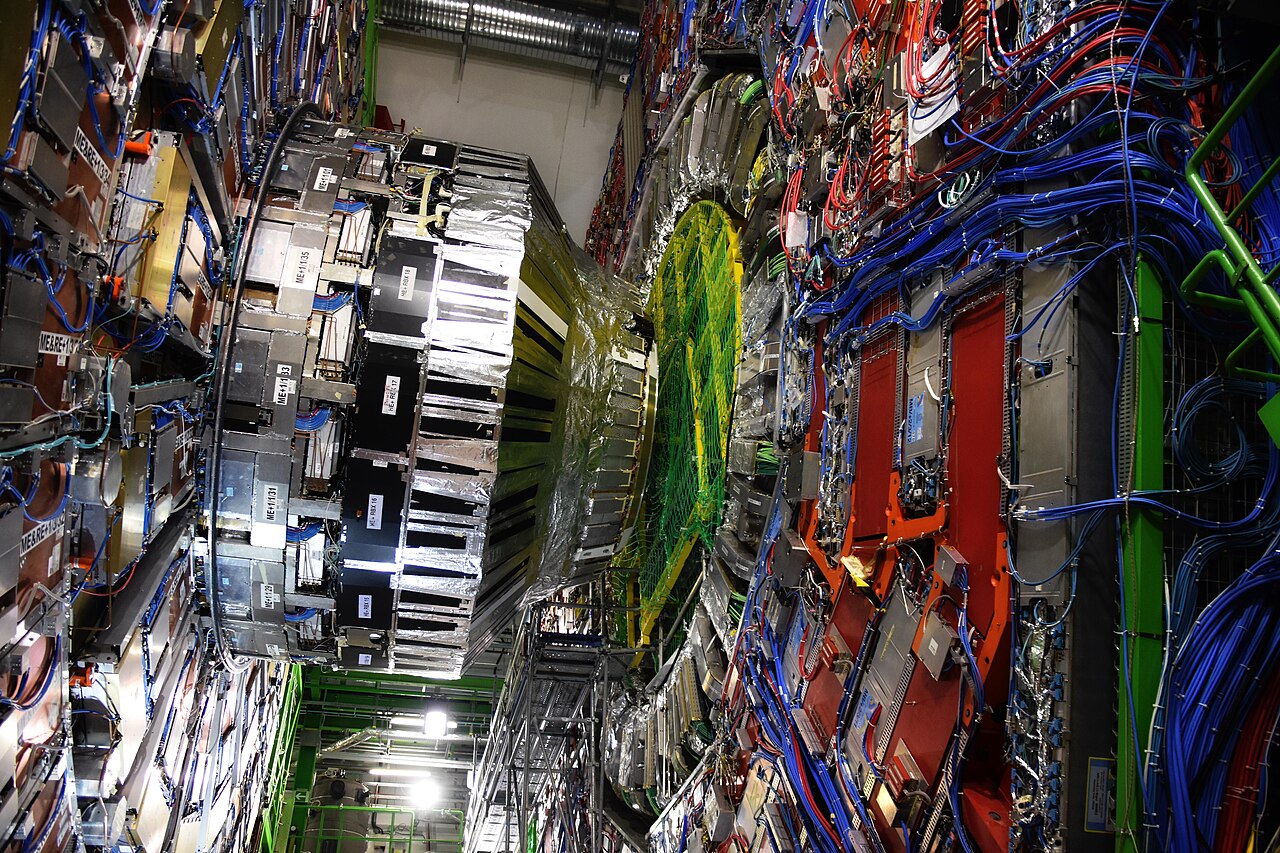
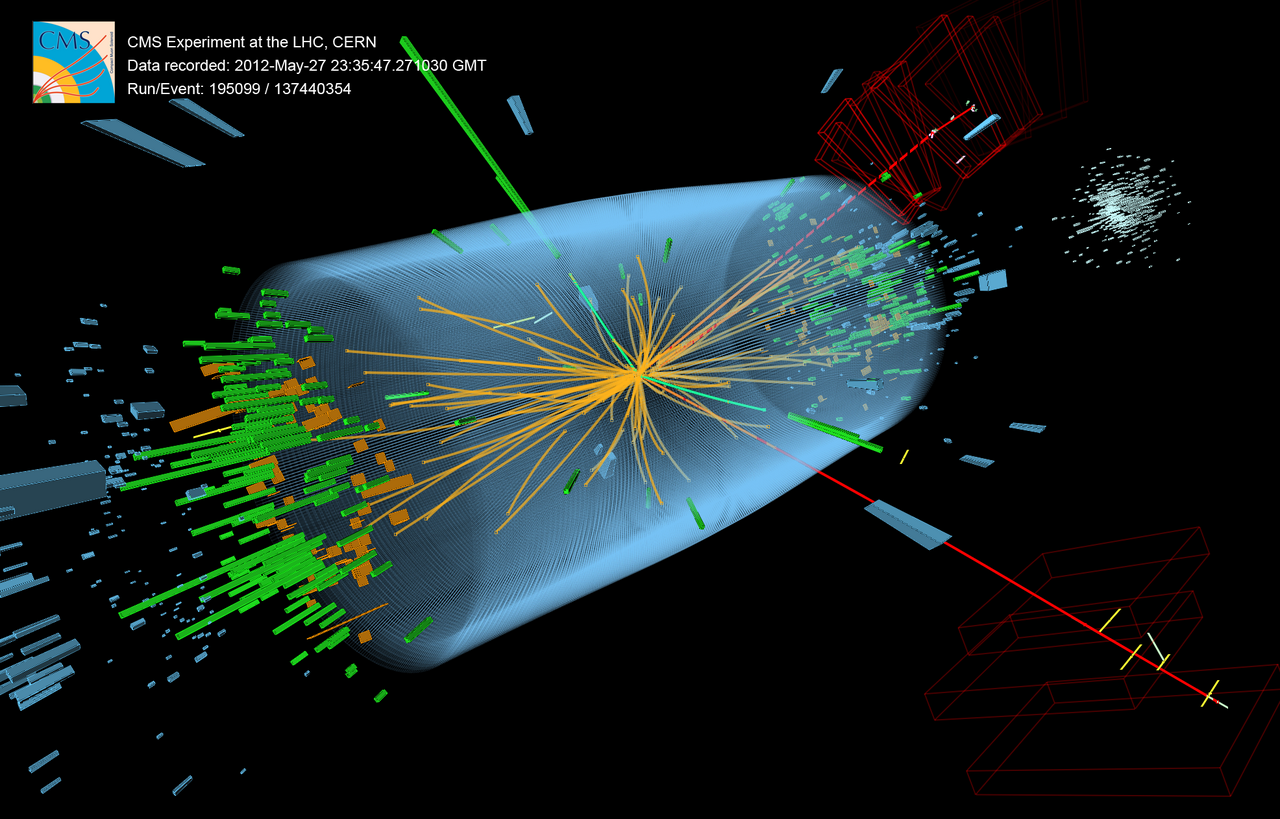
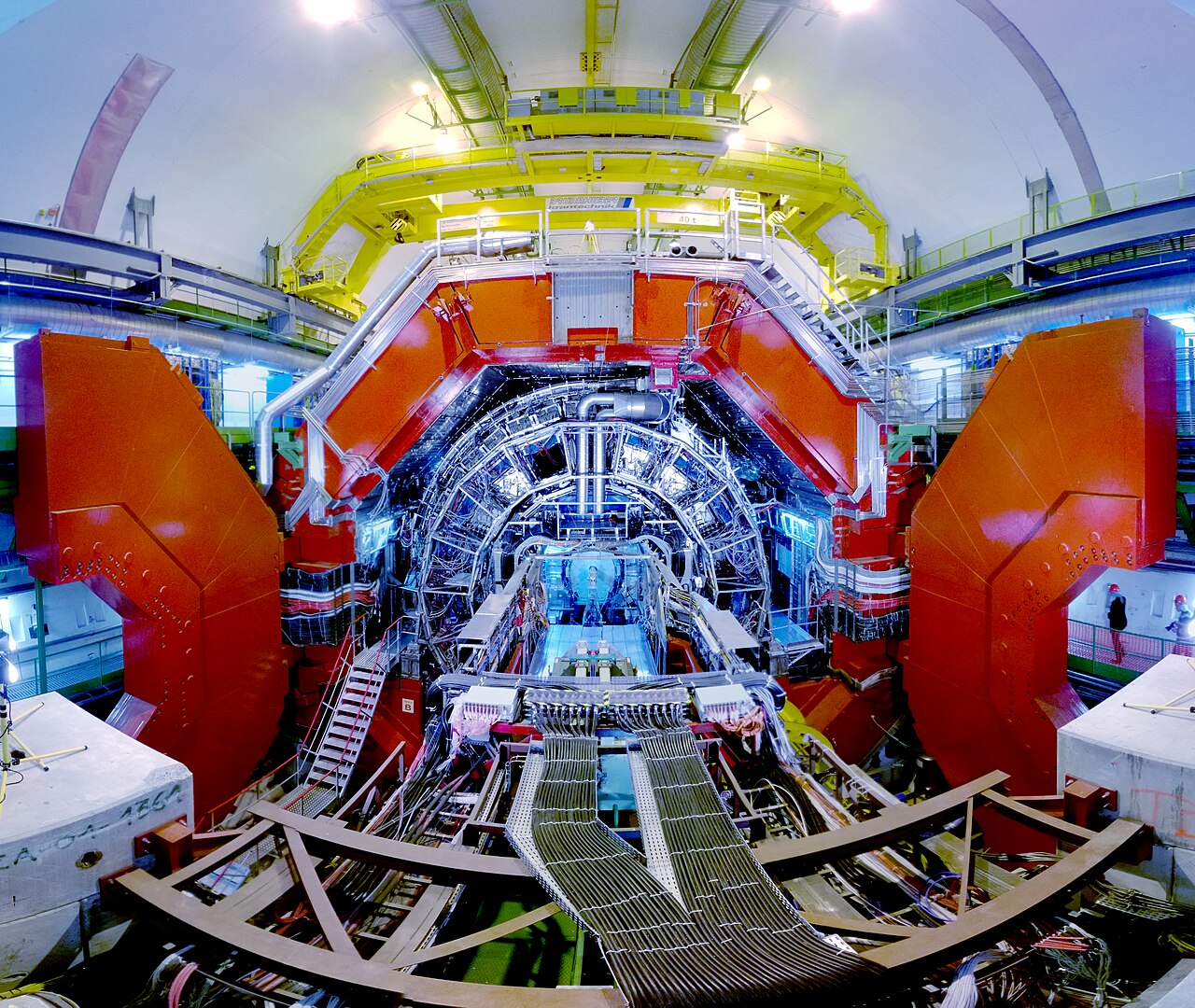
    Proposed in 1964 by Brout, Englert and Higgs. ATLAS and CMS at CERN announced the particle on 4 July 2012. (CERN)

    Nobel Prize 2013
  9. S9Solved 2003
    Poincaré ConjectureTopology

    Posed by Henri Poincaré in 1904. Grigori Perelman proved it in 2002–2003, the only Millennium Prize Problem solved so far. (Clay)

    $1M Clay prize, declined

Think you solved one? The Clay Mathematics Institute does not accept direct submissions. A solution must be published in a qualifying peer-reviewed outlet, wait at least two years, and win general acceptance from mathematicians (Clay rules). Publish first, then tell us at charles@digitalsuperintelligence.us and we will feature it here. No AI, this site included, can certify a proof.

Join the pursuit
Tackle the 13 · Build an AI physicist

Build your own hero analog.

An analog is an AI program built from 33 strengths of real physicists, living and dead, aimed at one problem. Each person may build three. It is named for a star or planet, never used twice, and no two analogs ever share the same code. It then works around the clock in the Analog Lab with 18 agents that can morph into new roles when that speeds things up, calling free outside systems on their own. Once deployed it takes no input from anyone. It is a program, not the people it draws on.

Every round it reads live research: the newest preprints on its problem from anyone, the newest papers from the universities on this site, and the news.

The one problem it works onChoose one
Random analog

One tap. The program picks the 33 strengths and names it.

Your own analog

Pick any strengths you care about, then let the program fill the rest to 33.

Your 33 strengths0 of 33

Tap a physicist to open their three strengths: education, a method, a signature idea. Pick as many or as few as you like; Fill to 33 does the rest.

Loading the physicists…

0 / 33
The Soviet Library · Translated, peer-reviewed, free · Run by 33 agents

The Soviet Library.

СОВЕТСКАЯ БИБЛИОТЕКА · 1937–1992

For forty years the best physics and mathematics on Earth was published behind a wall, in Russian, in journals most Western scholars never opened. The Journal of Experimental and Theoretical Physics and JETP Letters were translated cover to cover by the American Institute of Physics and are now free online; the mathematics journals sit on Math-Net.Ru with English titles and abstracts. This library gathers the papers that bear on the thirteen locked doors, with the history behind each: where the idea came from, what it answered, and what it led to on both sides of the wall. Every entry links to the paper itself, in its official English translation where one exists. Thirty-three agents keep it: thirteen scouts, three archivists and three verifiers work now; the translators, readers, historians, door-keeper and editor write once the engine is connected.
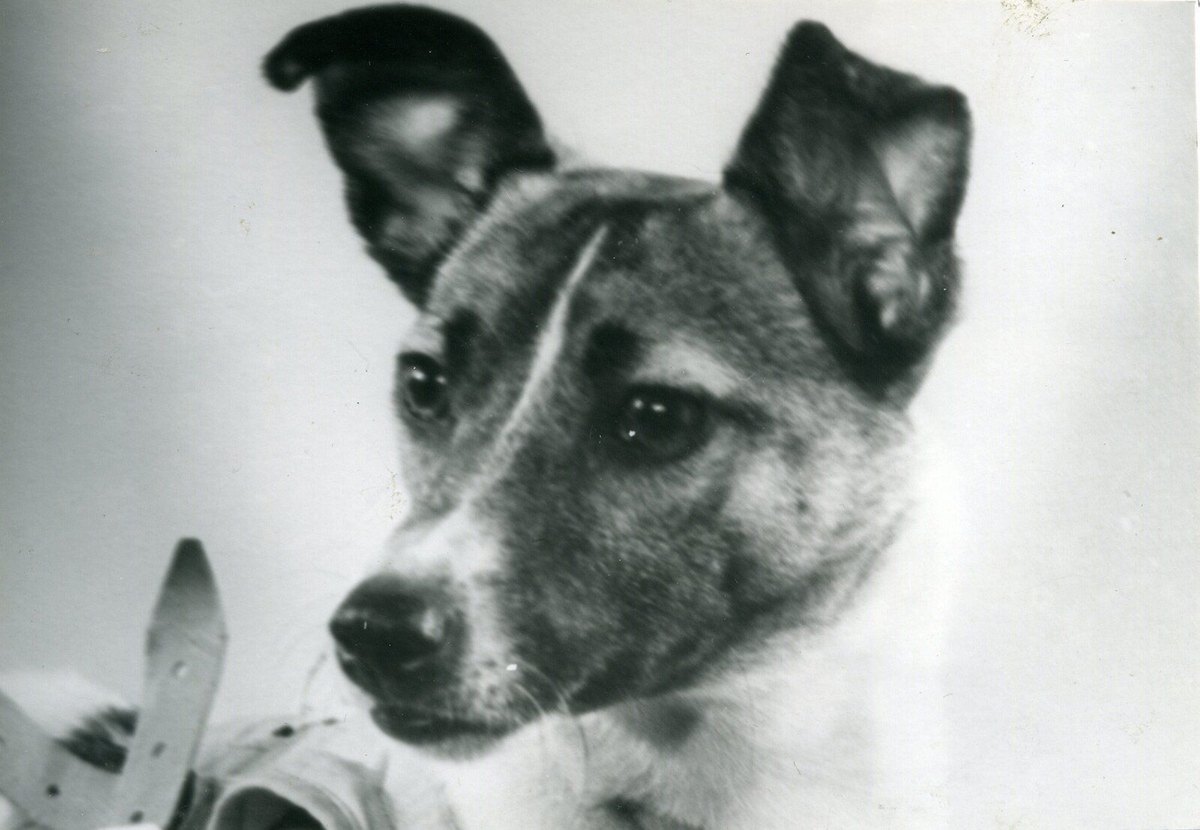
Soviet space-program photograph, 1957
1957. Photograph: Museum of Cosmonautics / Moscow Main Archive, via mos.ru, CC BY 4.0.
…papers shelved
…in official English translation
33agents on duty
…of the thirteen doors covered

The shelves Chosen and annotated by the house; every link checked

Opening the library…

The agents’ finds Pulled from the archives by the scouts; unread until the engine wakes the readers

The 33 agents Who does what, and what each did last

Sources: the JETP English archive (1955 onward, official translations, free), the JETP Letters English archive (1965 onward, free), and Math-Net.Ru for the mathematics journals (Russian originals with English titles and abstracts). Nothing here is paraphrased from a secondary source; the house notes are the house’s own and say so.

Codex Obscura · 44 entries · the fringe of the fringe, every link checked live

Codex Obscura.

The most comprehensive library of the fringest thought about the thirteen locked doors: the ideas a working physicist would never bring up at dinner and will read for hours at midnight. Each entry links to its actual source so you can judge it yourself. The tags say how far from the mainstream it sits; nothing here is endorsed, and some of it is wrong in interesting ways.

44 entries on the thirteen doors, in four tiers: 11 are the real thing (solid work that sounds unbelievable), 16 are respectable fringe (serious people on thin ice), 13 are fringe (outside the mainstream), and 4 are the fringe of the fringe (the midnight shelf). Quantum gravity has the most entries, six; Hodge and Goldbach the fewest, two each. Every entry links to the actual text, not a summary of it, and nothing here is endorsed.

What is ahead in this section
  1. The keyWhat the four colours mean, so you know how far from shore each entry sits.
  2. Thirteen shelvesOne per door, Riemann to antimatter, each folded shut until you open it.
  3. Send oneAn entry needs a link to the actual text; the address is at the end.

the real thing is solid work that sounds unbelievable · respectable fringe is serious people on thin ice · fringe is outside the mainstream · fringe of the fringe is the midnight shelf

01Riemann HypothesisWhere the zeros hide5
  1. A Hamiltonian for the zerosBender, Brody and Müller (2017) write down a quantum operator whose energy levels would be the Riemann zeros: the Hilbert–Pólya dream, in printrespectable fringe
  2. Odlyzko's tables of zerosBillions of zeros computed by hand, so to speak; the raw material of every midnight theorythe real thing
  3. Number theory and physics archiveMatthew Watkins's decades-old archive of every attempt to tie the zeta zeros to quantum chaos, music and the physical worldfringe
  4. De Branges, for thirty yearsLouis de Branges, who proved the Bieberbach conjecture, has posted proof after proof of the Riemann Hypothesis on his Purdue page since the 1980s; the field reads each onefringe
  5. viXra, number theoryThe un-arXiv, where the claimed proofs of the Riemann Hypothesis pile up by the hundredfringe of the fringe
02P vs NPProofs and hypercomputers4
  1. Woeginger's listGerhard Woeginger kept the running list of every claimed proof that P equals NP, and every claimed proof that it does notfringe
  2. The Deolalikar affairAugust 2010: an HP Labs researcher's claimed proof, and the week the internet refereed it liverespectable fringe
  3. NP-complete problems and physical realityScott Aaronson tours every physical trick proposed to beat NP: soap bubbles, time machines, relativistic computersrespectable fringe
  4. HypercomputationToby Ord's survey of machines that would compute the uncomputable, if the universe allowed themfringe
03Navier–StokesWater that thinks3
  1. Tao's fluid computerTerence Tao proves finite-time blowup for an averaged version and sketches a water-powered Turing machine as the road to the real thingrespectable fringe
  2. The Otelbaev claim2014: a Kazakh mathematician announces a proof in Russian; the world tries to translate it; a gap is foundfringe
  3. Too many answersBuckmaster and Vicol show the weak form of the equations has non-unique solutions: the water can do more than one thingrespectable fringe
04Yang–Mills and the mass gapGlue and ghosts3
  1. Dynin's discrete spectrumAlexander Dynin's claim that the Yang–Mills energy spectrum is infinite and discrete, posted and repostedfringe
  2. Frasca's mapping theoremAn independent physicist's long campaign to get the mass gap from a classical mapping to scalar fieldsfringe
  3. Glueballs on the latticeThe computer evidence that the gap exists, which is not a proof and never will bethe real thing
05Hodge ConjecturePhysicists in the garden2
  1. Mirror symmetry crashes the partyCandelas, de la Ossa, Green and Parkes (1991) used string theory to count curves on a quintic, beating the mathematicians at their own gamerespectable fringe
  2. Where the conjecture already failsHodge’s original version is false over the integers (Atiyah and Hirzebruch, 1961); Totaro’s paper is where that failure is studied, and the fringe asks what else is quietly falsethe real thing
06Birch and Swinnerton-DyerCurves with secrets3
  1. The elliptic-curve backdoorDual_EC_DRBG: the random-number generator built on an elliptic curve with a suspected NSA trapdoor, documented by the cryptographers who found itthe real thing
  2. Congruent numbersWhich whole numbers are the area of a rational right triangle: a thousand-year-old puzzle that BSD would settle, in Keith Conrad’s notesrespectable fringe
  3. The official statementWhat a proof would actually have to showthe real thing
07Quantum GravityTheories of everything, from everyone6
  1. An Exceptionally Simple Theory of EverythingGarrett Lisi, surfer, puts all of physics inside the E8 Lie group; cheered, then picked apartfringe
  2. The Wolfram Physics ProjectStephen Wolfram's claim that space is a hypergraph being rewritten, and physics falls outfringe
  3. Geometric UnityEric Weinstein's theory, presented on a podcast before it was written downfringe of the fringe
  4. The cellular automaton interpretationNobel laureate 't Hooft argues quantum mechanics is a deterministic automaton underneathrespectable fringe
  5. Emergent gravityErik Verlinde says gravity is not a force at all but entropy keeping booksrespectable fringe
  6. The simulation argumentNick Bostrom's 2003 paper, the reason half of Silicon Valley thinks physics is a rendering enginefringe
08Goldbach ConjectureTwo primes and a million dollars2
  1. Verified to four quintillionTomás Oliveira e Silva's computer check of every even number to 4 × 10¹⁸the real thing
  2. The Faber prizeIn 2000 a publisher offered $1 million for a proof, to sell a novel about Goldbach; nobody collectedfringe
09Twin Prime ConjectureThe primes' conspiracy3
  1. Unexpected biases in consecutive primesOliver and Soundararajan: primes avoid repeating their last digit, which nobody predictedrespectable fringe
  2. Zhang's 70 millionThe paper by an unknown lecturer that cracked bounded gaps and started a race to 246the real thing
  3. Polymath8The open, online, anyone-can-join project that drove Zhang’s gap from 70 million down, written up under a collective namerespectable fringe
10Collatz ConjectureThe problem that eats mathematicians4
  1. Lagarias's annotated bibliographyJeffrey Lagarias catalogs every serious and semi-serious paper on 3n+1, which is the closest thing to a map of this rabbit holethe real thing
  2. Bařina's Collatz verificationDavid Bařina's GPU project at Brno: every starting number below 2^71 verified to reach 1 (January 15, 2025), source code public, still runningfringe
  3. Tao: almost all orbitsAlmost every starting number almost reaches 1, which is as close as the best living mathematician gotthe real thing
  4. Lagarias’s 2021 overviewThe state of the problem by the man who has read everything on it, including why Conway’s generalizations are undecidablerespectable fringe
11Dark MatterOr no dark matter at all3
  1. MONDMilgrom's 1983 modified gravity, which fits galaxy rotation curves with no dark matter and still will not dierespectable fringe
  2. Superfluid dark matterBerezhiani and Khoury: dark matter is a superfluid, and MOND is what it looks like from insiderespectable fringe
  3. The Electric UniverseThe fringe of the fringe: gravity is overrated, the cosmos runs on electric currents. No peer review, large followingfringe of the fringe
12Dark EnergyOr no expansion at all3
  1. Tired light, 1929Fritz Zwicky’s original proposal that redshift is light losing energy, not space expanding; still the fringe’s favoritefringe
  2. The Big RipCaldwell, Kamionkowski and Weinberg: if dark energy grows, it tears galaxies, then atoms, apart at a calculable daterespectable fringe
  3. The Big Bang never happenedEric Lerner's 2022 essay that went viral after JWST's first images, and the replies it drewfringe of the fringe
13Matter vs AntimatterMirrors and time3
  1. Positrons going backwards in timeFeynman (1949): an antiparticle is a particle moving backward in time. Mainstream mathematics, fringe-sounding sentencethe real thing
  2. Does antimatter fall up?For decades the fringe hoped so; in 2023 ALPHA-g dropped antihydrogen and it fell downthe real thing
  3. The anti-universeBoyle, Finn and Turok: before the Big Bang sits a mirror universe made of antimatter running backwardrespectable fringe

Got one that belongs here? It needs a link to the actual text. Send it to charles@digitalsuperintelligence.us.

Unsolved · What a city on Mars still needs

Thirteen doors SpaceX needs open.

Starship is the key; these are the locks. Each one is an engineering or science problem nobody has solved at the scale a Mars city needs. The sources are NASA’s own pages and SpaceX’s.

0people have stood on Mars
13doors between Starship and a city
2years between Mars launch windows

Read the thirteen as one trip. Doors 1 to 3 are leaving Earth with full tanks: refilling in orbit, flying the Ship again, keeping the propellant cold for six months in sunlight. Door 4 is landing a hundred tonnes with no rehearsal. Doors 5 to 7 are making the ride home and the power to make it: propellant proved only in grams, ice mapped but never mined, megawatts through dust storms and nights. Doors 8 to 11 keep people alive: radiation with no limits set yet, three-eighths gravity with zero data points, a closed loop with no resupply, and dust in every seal. Door 12 has never been done by anyone: launching from Mars. Door 13 is the one that makes the rest possible at twenty light-minutes: running itself. A fourteenth door is law. Every card links to NASA’s own pages or SpaceX’s.

What is ahead in this section
  1. The thirteen tilesEach with its status line (demonstration pending, never done, designs only) and its source.
  2. The fourteenth doorPlanetary protection law: the one no engineer can open.
  3. The portalOpened one of these, or a locked door? File it here with the published solution; five a day per visitor.
  4. Every upcoming launchStarship and Falcon flights with live-feed video tiles; then every open job and Mars.
  1. 01NASA-funded 2020
    Refilling in orbitStarship

    A Mars ship leaves Earth orbit full, so Starship must be refilled by other Starships, tank to tank, in zero g. NASA gave SpaceX $53.2 million in 2020 to demonstrate moving 10 metric tons of liquid oxygen between tanks on one vehicle (NASA). Nobody has done it at this scale.

    Demonstration pending
  2. 02The whole plan rests on it
    Flying the Ship againReusability

    Falcon 9 boosters land and fly again. No orbital upper stage has ever come back through re-entry and flown again without months of work. Starship’s ship must land and go again with its heat shield intact, over and over (SpaceX).

    Rapid reuse: not yet shown
  3. 03Six months in sunlight
    Keeping propellant coldCryogenics

    Liquid oxygen and methane boil away in sunlight. A Mars ship holds them for six months or more on the way out, and the return load must wait on Mars. Cryogenic fluid management had its own line of NASA awards in 2020 for exactly this reason (NASA).

    Zero boil-off: not flown at scale
  4. 04No rehearsal possible
    Landing 100 tonnes on MarsEntry, descent, landing

    Mars has a very thin atmosphere (NASA): too thin for parachutes to land a hundred tonnes, thick enough to burn it. Starship must fly in on its engines, supersonic, into dust it cannot see through. Nothing near that mass has ever been landed anywhere but Earth.

    First try is the real thing
  5. 05Proved in grams
    Making the ride home on MarsPropellant production

    The return propellant is made on Mars: methane and oxygen from Martian carbon dioxide and water ice. NASA’s MOXIE on Perseverance proved the chemistry, making 122 grams of oxygen in all, 12 grams an hour at best (NASA). A Starship needs hundreds of tonnes.

    Grams done; tonnes to go
  6. 06Mapped, not mined
    Finding and mining the iceResources

    Phoenix verified water ice just under the surface of the Martian arctic in 2008 (NASA). A propellant plant needs ice at a warmer, lower-latitude landing site, and machines that dig it out and melt it with nobody there to fix them.

    No digging machine has flown
  7. 07Megawatts needed
    Power through dust storms and nightsEnergy

    Solar panels dim under Mars dust and die in a global storm. NASA’s Fission Surface Power project asked industry for a reactor under six metric tons that makes 40 kilowatts (NASA). A propellant plant needs megawatts. No reactor has ever run on another world’s surface.

    Reactor: designs only
  8. 08No limits exist yet
    Radiation, there and backCrew health

    Outside Earth’s magnetic field a crew takes galactic cosmic rays and solar storms the whole way. NASA says there is insufficient knowledge of the health effects to set crew exposure limits and design requirements for long-duration missions (NASA).

    Shielding a ship: unsolved
  9. 09Zero data points
    Living in three-eighths gravityCrew health

    In weightlessness, bones lose 1 to 1.5 percent of their mineral density every month (NASA). No one has ever lived in Mars gravity, so nobody knows whether it is enough to stop that, or what a child would grow up like there.

    Nobody has tried
  10. 10Years, no resupply
    A closed loop that never breaksLife support

    The space station now recovers about 98 percent of its water (NASA), with Earth a few hours away for spare parts. A Mars crew needs air, water and food loops that run for years with no resupply at all.

    Food loop: unsolved
  11. 11In every seal
    Toxic dustSurface

    Phoenix found perchlorate in the Martian soil (NASA). The dust is fine, electrostatic and toxic; it grinds seals, coats panels and would follow every suit back inside the habitat.

    No habitat has met it
  12. 12Never done
    Launching from MarsAscent

    Every Mars mission has been one way. NASA’s Mars Sample Return was the plan to fly the first rocket off Mars, and it has stalled (NASA). Starship must do it with people aboard, fueled from the plant in door 05.

    Zero launches from Mars, ever
  13. 13Minutes each way
    Running itselfAutonomy

    Radio takes minutes each way, so no one on Earth can fly a landing or handle an emergency. Every two years the Sun sits between the planets and NASA stops sending commands for two weeks (NASA). A city has to run itself.

    Autonomy is the only answer

The fourteenth door is legal. The Outer Space Treaty, Article IX, requires exploration conducted so as to avoid harmful contamination of celestial bodies (UNOOSA), and COSPAR’s planetary protection panel writes the rules missions follow (COSPAR). A crewed ship cannot be sterilized to today’s standard. That rule has to change before the first boot touches Mars.

Opened one of these doors? Submit it here.A link to the published work is required

This is the portal for solved doors: any of the thirteen SpaceX doors, the fourteenth, or one of the thirteen locked doors. Your submission is saved and read by a person. Publish first; a claim without a public paper, preprint, report or repository cannot be reviewed.

The God particle · The one big question that did get answered

The particle that gives everything its weight.

The Higgs boson is proof that a locked door can open: proposed on paper in 1964, found in a machine 48 years later. Two parts: the story in plain words for everyone, then the depository, the primary record for people who work on it.

Two parts, for two readers. In plain words: six numbers that tell the whole story (1964, 4 July 2012, 125.13 GeV, spin 0, 58 percent, one in a billion) and the story itself, written for anyone. The depository: 18 links in five shelves, every one primary: the three 1964 papers that wrote the mechanism down, the two discovery papers of 4 July 2012 and the Nobel that followed, the ten-year reviews that mapped its interactions, the reference shelf working physicists keep open, and the real collision data anyone can download.

What is ahead in this section
  1. In plain wordsThe six numbers, then why a field can give a particle its weight.
  2. The depositoryFive shelves, 18 primary sources, from the 1964 papers to CERN Open Data.
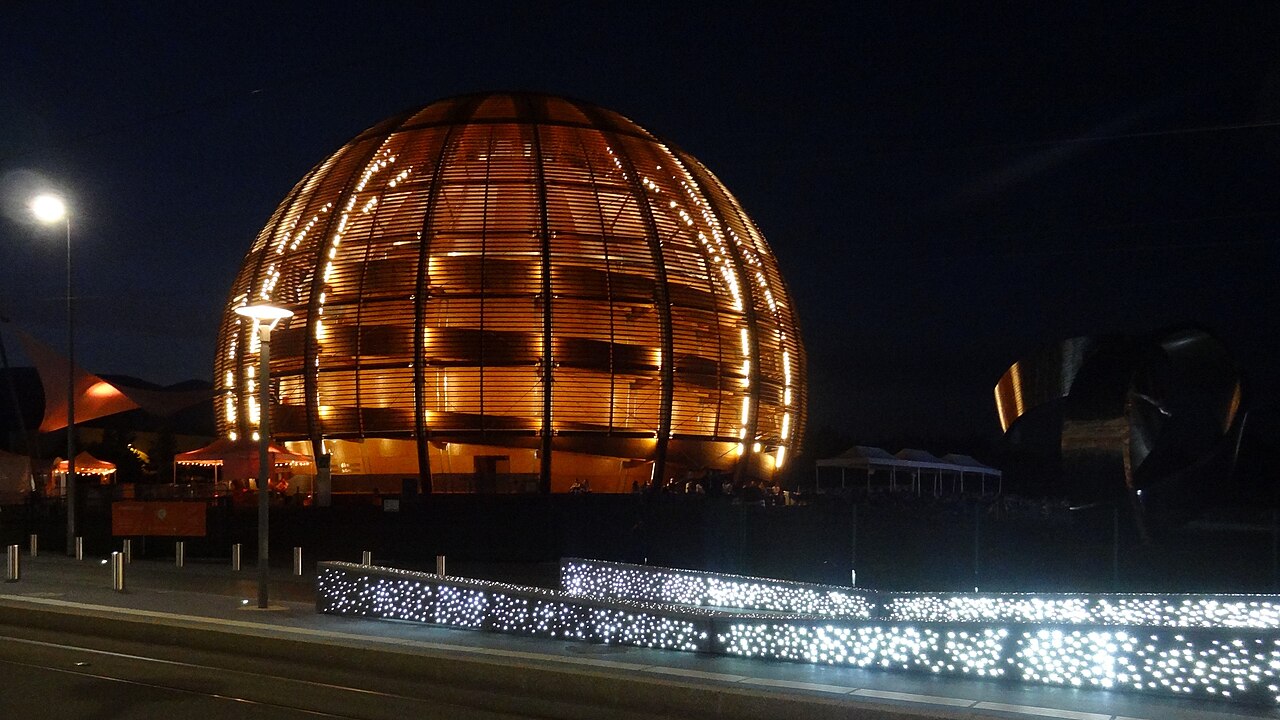
  3. CERN’s open doors56 links to the data, software, lectures and media CERN gives away; then the collider itself.
1964the field proposed by Brout, Englert and Higgs
4 July 2012discovery announced by ATLAS and CMS at CERN
125.13 GeVits mass, ± 0.11 (Particle Data Group, 2026)
Spin 0the only known fundamental particle with none
58%of Higgs bosons decay to a pair of bottom quarks
1 in a billionLHC collisions produce one

In plain words For everyone, no physics required

What it is

The Higgs field fills the whole universe. Particles get their mass by interacting with it; the photon does not interact with it, so the photon has no mass. The Higgs boson is the ripple in that field, the thing you can actually make and measure. It appears in about one in a billion collisions at the Large Hadron Collider. (CERN: The Higgs boson)

Why it is called the God particle

Leon Lederman, who won the 1988 Nobel Prize for the muon neutrino, gave it the name in his 1993 book “The God Particle.” He had wanted to call it the goddamn particle, for how hard it was to find; his publisher would not allow it. Physicists mostly avoid the nickname. (Science News)

How it was found

Two experiments at CERN, ATLAS and CMS, each saw the same new particle in the debris of proton collisions and announced it together on 4 July 2012. By March 2013, with two and a half times more data, its spin was confirmed as zero: it was a Higgs boson. Its interaction with tau leptons was seen in 2016 and with top and bottom quarks in 2018. (CERN; APS Physics on the bottom-quark decay)

The prize

The 2013 Nobel Prize in Physics went to François Englert and Peter Higgs “for the theoretical discovery of a mechanism that contributes to our understanding of the origin of mass,” confirmed by the ATLAS and CMS discovery. Robert Brout had died in 2011. Peter Higgs died on 8 April 2024, aged 94. (Nobel Prize; University of Edinburgh)

The machine

The LHC is a 26,659 m ring about 100 m underground, its superconducting magnets cooled to 1.9 K, colder than outer space, colliding protons at 13.6 TeV. It first circulated protons on 10 September 2008. The High-Luminosity upgrade, due to run from about 2030, aims for at least 15 million Higgs bosons a year. (CERN: The LHC; CERN: HL-LHC)

What is still open about it

Is it one particle or part of a larger Higgs family? Does it interact with itself? Why is its mass so small? Does it help explain why matter outlasted antimatter, the thirteenth locked door on this page? Could dark matter show up through it? Those are the questions the next decade of collisions is built to ask. (CERN)

The depository For the experts: the primary record, nothing secondhand

The 1964 papersWhere the mechanism was written down3
  1. Englert and Brout, Broken Symmetry and the Mass of Gauge Vector Mesons (1964)Physical Review Letters 13, 321; the first of the three
  2. Higgs, Broken Symmetries and the Masses of Gauge Bosons (1964)Physical Review Letters 13, 508; the paper that predicts the boson
  3. Guralnik, Hagen and Kibble, Global Conservation Laws and Massless Particles (1964)Physical Review Letters 13, 585; the third, independent derivation
The discoveryThe two papers of 4 July 2012 and what followed4
  1. ATLAS: Observation of a new particle in the search for the Standard Model Higgs boson (2012)Physics Letters B 716, 1; the ATLAS discovery paper
  2. CMS: Observation of a new boson at a mass of 125 GeV (2012)Physics Letters B 716, 30; the CMS discovery paper
  3. ATLAS and CMS: Combined measurement of the Higgs boson mass (2015)The first joint mass, from 7 and 8 TeV data
  4. The 2013 Nobel Prize in PhysicsEnglert and Higgs; the citation, lectures and documents
Ten years onThe full map of its interactions2
  1. ATLAS: A detailed map of Higgs boson interactions ten years after the discovery (2022)Nature 607, 52; every coupling measured so far
  2. CMS: A portrait of the Higgs boson ten years after the discovery (2022)Nature 607, 60; the companion portrait
The reference shelfWhat working physicists keep open4
  1. Particle Data Group: Status of Higgs boson physics (2025 review)The standing review, revised every edition
  2. Handbook of LHC Higgs Cross Sections: 4. Deciphering the Nature of the Higgs SectorThe LHC Higgs Working Group’s yellow report, the numbers every analysis uses
  3. LHC Higgs Working GroupCross sections, branching ratios and recommendations, maintained at CERN
  4. Higgs Physics at the HL-LHC and HE-LHC (2019)What the next decade of collisions is built to measure
Data and the literatureWork with the real thing5
  1. CERN Open Data: Higgs-to-four-lepton analysis example (2011–2012 data)Rediscover the Higgs yourself from the released collision data
  2. INSPIRE: every paper with Higgs boson in the title, most cited firstThe literature database the field runs on
  3. CERN: The Higgs bosonCERN’s own account, kept current
  4. ATLAS: The Higgs boson, a landmark discoveryThe ATLAS collaboration’s physics pages
  5. CMS: Higgs bosonThe CMS collaboration’s physics pages
String theory · The most-travelled road to door seven, quantum gravity

Everything is a vibrating string.

One idea, pushed as far as it will go: the smallest things are not points but tiny loops and strands of energy, and every particle is one note that such a string can play. Pull on the idea and gravity falls out of it uninvited, the world needs ten dimensions, and five different theories turn out to be one. Fifty-eight years after the first equation, nobody has measured a string. This room holds what the theory says, what it has delivered, what it has not, and where to learn it at no cost. The links go to the original papers.

The one picture A string, its notes, and why a note is a particle

A guitar string of fixed length can only vibrate in whole numbers of half-waves: one hump, two, three. Each pattern is a note. String theory says a fundamental string is the same, except that each of its notes shows up to us as a different particle, with a different mass and spin. Press a mode below and watch the string change its note. The drawing is a cartoon: the real notes are quantum states of a string in ten dimensions, but the logic is the same. Mode 2 is the one that matters most: in every version of the theory a closed string vibrating this way has exactly the properties of the graviton, the particle that would carry gravity. That is why the theory is on this site at all; it is the only reason anyone kept working on it after 1974 (Scherk and Schwarz, 1974; Yoneya, 1974).

One hump. The string’s lowest note. In the simplest bosonic version this note comes out with imaginary mass, the tachyon, which is one reason the real theory needs supersymmetry.

How small From you to the string, on one ruler

Each step on this ruler is ten times smaller than the last. A string is thought to sit near the Planck length, 1.616 × 10⁻³⁵ metres (CODATA, NIST). A proton, the smallest thing most people have heard of, has a charge radius of 8.4 × 10⁻¹⁶ metres (CODATA, NIST). The gap between those two numbers, nineteen steps of ten, is the whole problem: no machine reaches anywhere near it, which is why the Large Hadron Collider was never expected to see a string directly.

1 myou 10⁻⁵ ma cell 10⁻¹⁰ man atom 8.4×10⁻¹⁶ ma proton 1.6×10⁻³⁵ ma string nineteen steps of ten with nothing measured in them

Five theories that were one The 1995 map

By 1985 there were five consistent superstring theories and no way to choose. In 1994 Hull and Townsend argued the five were linked by dualities, exact dictionaries between theories that look nothing alike (arXiv hep-th/9410167). In 1995 Witten showed they were five corners of one eleven-dimensional theory he called M-theory, whose low-energy limit is eleven-dimensional supergravity: Type IIA at strong coupling grows an eleventh dimension, the E₈×E₈ heterotic string does the same on an interval, and Type IIB is its own strong-coupling dual (arXiv hep-th/9503124; see also Hořava and Witten). The same year Polchinski found that the theory contains higher-dimensional objects, D-branes, that strings can end on (arXiv hep-th/9510017). Nobody has written down what M-theory is in full; the map below is the shape of what is known.

M11 dimensions Heterotic E₈×E₈Gross, Harvey, Martinec, Rohm Heterotic SO(32)the other one Type Iopen and closed Type IIBclosed, chiral Type IIAclosed, non-chiral T-dualityS-dualityorientifoldT-duality strong coupling strong coupling low energy: 11-d supergravity

The record Fifty-eight years, in the papers themselves

1968
The first formula

Gabriele Veneziano writes an amplitude for colliding hadrons that nobody can derive from particles. It is the first string formula, found before anyone knew it was about strings.

INSPIRE
1969
It is a string

Nambu, Nielsen and Susskind each see that Veneziano’s formula is what you get from a vibrating one-dimensional object.

Nambu · Koba and Nielsen · Susskind
1971
Fermions, and superstrings

Ramond puts fermions on the string; Neveu and Schwarz build the other half. Supersymmetry is born inside string theory, years before anyone used it for particles.

Ramond · Neveu and Schwarz
1974
Gravity falls out

The theory had failed as a theory of hadrons. Scherk, Schwarz and, independently, Yoneya notice that its massless spin-2 note is a graviton, and propose it as a theory of everything instead.

Scherk and Schwarz · Yoneya
1976
The GSO projection

Gliozzi, Scherk and Olive remove the tachyon and make the spectrum supersymmetric. The superstring becomes consistent.

INSPIRE
1984
The first revolution

Green and Schwarz show the anomalies cancel for gauge group SO(32). The rush into string theory begins.

INSPIRE
1985
Heterotic strings and Calabi–Yau

Gross, Harvey, Martinec and Rohm build the heterotic string; Candelas, Horowitz, Strominger and Witten curl the six extra dimensions into Calabi–Yau shapes to get something like our world.

Heterotic · Vacuum configurations
1996
Black hole entropy, counted

Strominger and Vafa reproduce the Bekenstein–Hawking entropy of a black hole by counting string states. The first quantitative success of any quantum theory of gravity.

arXiv
1997
Holography

Maldacena’s AdS/CFT: a string theory with gravity in a curved space equals a quantum field theory without gravity on its boundary. On INSPIRE it is the most cited theory paper in high-energy physics, with more than 22,000 citations.

Maldacena · GKP · Witten
2000
Too many universes

Bousso and Polchinski count the ways to thread fluxes through the extra dimensions and find a vast number of possible vacua. The landscape begins.

arXiv
2003
KKLT and the landscape

Kachru, Kallosh, Linde and Trivedi construct vacua with positive energy like ours; Susskind names the landscape and argues for anthropic reasoning. The field splits over it.

KKLT · Susskind
2005
The swampland

Vafa asks which low-energy theories cannot come from string theory at all. The answer, if it can be made sharp, would be a prediction.

Vafa · Palti’s review
2018
Trouble with de Sitter

Obied, Ooguri, Spodyneiko and Vafa conjecture that stable universes with positive energy, like the one we measure, may not exist in string theory. Still contested.

arXiv
2026
Where it stands

Quanta asks working theorists whether strings are still the best hope for a theory of everything, and gets every answer.

Quanta

What it has delivered, and what it has not Both columns are true at once

Delivered

  • A quantum theory in which gravity is not optional: the graviton is a vibration mode, and the theory is finite order by order where general relativity alone is not (1974).
  • The first microscopic count of black-hole entropy that matches Hawking’s formula (Strominger and Vafa).
  • Holography: gravity in a volume equals a quantum theory on its surface (Maldacena), now a working tool far outside string theory.
  • The unification of five theories and supergravity into one framework (Witten), and D-branes (Polchinski).
  • Supersymmetry itself, which began on the string in 1971 (Ramond).

Not delivered

  • A single experimental test. No measurement has ever required a string to explain it.
  • Supersymmetric particles at the LHC. The Particle Data Group’s 2025 review records the absence of any experimental evidence for supersymmetry so far (PDG). Low-energy supersymmetry is not required by string theory, but its absence removed the most hoped-for signal.
  • A unique prediction. The landscape of vacua is enormous (Bousso and Polchinski; Susskind), and whether our universe’s positive energy fits in it at all is disputed (de Sitter swampland).
  • A definition of M-theory. The central node on the map above is a name for a theory nobody has written down.
  • The Yang–Mills mass gap, door four on this site, which the Clay Institute still lists as open (Clay); string dualities inspired approaches but not a proof.

Learn it, free From a first lecture to the full course

Susskind, Stanford: lecture 1 of 10Play
Brian Greene, TED: 19 minutesPlay
David Tong’s lecture notes, CambridgeThe free textbook most graduate students actually read first; the full PDF is also on arXiv.
MIT 8.251, String Theory for UndergraduatesBarton Zwiebach’s course on OpenCourseWare: syllabus, notes, problem sets, free.
The state of the field, 2026Quanta Magazine’s long report, with the critics and the defenders in their own words.
Door seven on this siteQuantum gravity among the thirteen locked doors, with its facts, stories and the newest papers.
The double-slit experiment · One photon at a time · Why looking changes the answer

One photon, two slits, and it knows if you are watching.

Fire light at a wall with two narrow slits and a striped pattern appears behind it: the light went through both slits as a wave and interfered with itself. Now turn the light down until only one photon is in the apparatus at a time. The stripes still build up, dot by dot, so each single photon must somehow go through both slits. Then put a detector at the slits to see which one each photon takes. The stripes vanish. Richard Feynman wrote that this experiment “contains the only mystery” of quantum mechanics (Feynman Lectures, III-1). This bench lets you run it, then explains, as plainly as the physics allows, why observation changes the outcome and what that does and does not mean.

Run it A working bench: photons arrive one at a time

Each red dot is one photon landing on the screen at the right. The barrier in the middle has two slits. Fire a few and the dots look random. Fire a thousand and the stripes appear, with a central bright band and dark bands where no photon ever lands, even though every photon went through alone. Switch on Watch the slits and the detector tags each photon with the slit it used: the stripes disappear and two plain humps take their place. Switch it off and the stripes return. The probabilities drawn here are the real ones for two slits (a cos² interference term times the single-slit envelope), so the pattern you build is the pattern the experiment gives.

detections 0

What actually happens In six plain steps

  1. A photon is not a tiny ball with a position. Between the source and the screen it is described by a wave of possibility that passes through both slits, because nothing stops it.
  2. The two parts of that wave meet again at the screen. Where crest meets crest the chance of a detection is high; where crest meets trough it is zero. That is the stripe pattern.
  3. The photon is only ever detected at one point. Which point is random, with the stripe pattern as the odds. One photon makes one dot; ten thousand make the stripes.
  4. To see which slit a photon used, something must interact with it: a detector, an atom, a stray molecule. That interaction leaves a record of the path.
  5. Once a record of the path exists anywhere, the two possibilities can no longer add up as one wave. They are now tied to two different states of the detector, and waves tied to different records do not interfere. The stripes go.
  6. If the record is destroyed before anyone could read it, the stripes come back. The experiment has been done. Reality cares about whether the information exists, not about whether a person looks.

Why observation changes reality And what it does not mean

The mechanism, without mysticism

“Observation” in quantum mechanics means any physical interaction that correlates the system with something else. A detector at a slit becomes correlated with the photon: detector state A goes with slit A, state B with slit B. The photon’s two paths are now entangled with two distinguishable states of the world, and the mathematics is exact: the interference term between them vanishes in proportion to how distinguishable those states are. Partial information gives partial stripes. This is called decoherence, and it is why big things never show interference: a dust grain is bumped by air molecules and photons billions of times a second, each bump a tiny “observation” (review: Schlosshauer, 2003; Stanford Encyclopedia).

Three experiments nail this down. The quantum eraser (Kim, Yu, Kulik, Shih and Scully, 2000) tags photons with which-path information and then erases the tag; the stripes come back only for the photons whose tags were erased (arXiv). Wheeler’s delayed choice, realized with single photons in 2007, decides whether to look for a path only after the photon has already passed the slits; the result is the same as if the choice had been made first (Jacques et al.). And heat alone does it: hot C70 molecules lose their interference as they radiate photons that carry away their position, with no detector in sight (Hackermüller et al., Nature 2004).

What it does not mean

It does not mean a mind is required. A photographic plate, a molecule or a wisp of thermal radiation collapses the stripes exactly as a physicist does, and no experiment has ever found a difference between a conscious observer and an unconscious one.

It does not mean you can change the past. In the delayed-choice quantum eraser the record of all the photons, taken together, is plain noise; the stripes appear only when results are sorted afterward using the eraser’s data. In Wheeler’s delayed choice the late decision changes nothing that was already recorded. No signal travels backward and none travels faster than light.

It does not mean anything goes. The outcome of each run is unpredictable; the odds are predicted to as many decimal places as anyone has measured. Quantum mechanics is among the most precisely tested theories in science, and the 2022 Nobel Prize went to the experiments with entangled photons that established the violation of Bell inequalities, its strangest prediction (Nobel press release).

The record Two centuries of the same experiment, bigger things each time

1804
Thomas Young: light is a wave

Young’s Bakerian Lecture to the Royal Society describes interference fringes and argues light behaves as a wave, against Newton.

Royal Society
1927
Electrons diffract

Davisson and Germer scatter electrons off a nickel crystal and see a diffraction pattern: matter is a wave too.

Physical Review
1976
One electron at a time

Merli, Missiroli and Pozzi in Bologna build the pattern from single electrons in an electron microscope.

American Journal of Physics
1989
The famous film

Tonomura’s team at Hitachi records single electrons arriving one by one until the stripes emerge. The video is below.

American Journal of Physics · Hitachi
1999
Whole molecules

Arndt, Zeilinger and colleagues send C60 buckyballs, sixty atoms each, through a grating and see interference.

Nature
2000
The quantum eraser

Which-path information is recorded, then erased; interference returns only where the record is gone.

Kim et al.
2004
Heat erases the stripes

Hot molecules lose interference by radiating; decoherence measured directly, with no detector.

Nature
2007
Delayed choice, for real

Jacques and colleagues realize Wheeler’s thought experiment with single photons and a choice made after the fact.

arXiv
2012
Watching molecules land

Juffmann and colleagues film the interference pattern of large molecules forming one molecule at a time.

Nature Nanotechnology
2013
Feynman’s version, exactly

Bach, Pope, Liou and Batelaan do the electron double slit with a movable mask covering one slit, the two slits or neither, as Feynman described it.

arXiv
2019
Two thousand atoms

Fein and colleagues in Vienna show interference for molecules heavier than 25,000 proton masses, the record for a quantum superposition of matter.

Nature Physics

What it means, honestly Five readings physicists hold; none is settled

Everyone agrees on the stripes and on the mathematics. What the mathematics is about is still argued, and the arguments are serious. The entries below are from the Stanford Encyclopedia of Philosophy, written by specialists and refereed.

Copenhagen

The wave is a tool for predicting outcomes; asking which slit the photon “really” took when nothing measured it is a question without content. Bohr and Heisenberg’s view, still the working default in most labs.

Read
Many worlds

The wave never collapses. Both paths happen; the detector, the room and you split into branches that no longer interact. Interference vanishes because the branches are now distinct, not because anything was destroyed.

Read
Pilot wave (de Broglie and Bohm)

The photon is a particle with a real position, guided by a real wave that goes through both slits. Looking disturbs the wave, and the pattern goes. Fully deterministic and fully consistent with every experiment.

Read
QBism

The wave is an agent’s own expectations. “Collapse” is the agent updating on new experience, nothing in the world snapping shut.

Read
Decoherence, and what it leaves open

Decoherence explains why the stripes disappear and why big things look classical. It does not by itself explain why one outcome happens rather than another; that remains the measurement problem.

Read

Watch it happen, free The real footage and the best explanations, no account needed

THE ORIGINAL FOOTAGE
Hitachi: single electrons, one by onePlay
DO IT WITH SUNLIGHT
Veritasium: Young’s experiment, outdoorsPlay
THE EXPLANATION
Royal Institution: Jim Al-KhaliliPlay
THE UNIVERSITY COURSE
MIT 8.04, lecture 1: superpositionPlay
TWO MINUTES
minutephysics: wave-particle dualityPlay
THE PHYSICISTS ARGUE
Sixty Symbols: what it meansPlay

Door seven, quantum gravity, is the attempt to put this wave and Einstein’s curved spacetime into one theory; string theory is the most-travelled road to it, and the thirteen locked doors hold the rest.

Respected dissent · Cosmology

The case against the Big Bang.

The standard model (ΛCDM: a hot Big Bang, inflation, dark matter, dark energy) is the best-tested story of the universe there is, and it has real cracks. These are the strongest pieces of evidence respected scientists have put on the record against it, each with its paper. Most hit the model’s parts; a few hit the beginning itself.

5σthe Hubble tension, by the SH0ES team’s count
13published lines of evidence below
1Nobel laureate listing the anomalies in his own model

The thirteen lines of evidence sort into five attacks. The expansion rate (1): the universe measured today and the universe inferred from its infancy disagree at five sigma. The early universe (2, 3): galaxies too big too soon in Webb’s images, and a lithium shortfall of four to five sigma that has never been explained. The microwave sky and the principle beneath it (4, 5): anomalies Planck confirmed, and a quasar dipole at 4.9 sigma against the assumption that the universe looks the same in every direction. Inflation and dark energy (6 to 9): a founder of inflation who no longer believes it, the acceleration result re-examined, DESI’s hint that dark energy is changing, and a rival model that fits with no dark energy at all. Structure that should not exist (10 to 13): a universe twice as old, a 7-sigma void we may sit in, the cluster El Gordo, and the Nobel laureate’s own list of his model’s cracks. Most of these hit a part of the model; a few (2, 6, 10) hit the beginning itself. The defenders get the last word at the end.

What is ahead in this section
  1. The thirteen tilesEach with its significance, its field, and the paper that put it on the record.
  2. What the model gets rightThe defenders’ case: the predictions ΛCDM has passed, which is why it is still the standard.
  3. The door that did openThe Higgs: proof that a 48-year wait can end. Then the thirteen locked doors.
  1. 015 sigma
    The Hubble tensionExpansion rate

    Measured directly, the universe expands at 73.04 ± 1.04 km/s/Mpc; the Big Bang model, fed the early universe, predicts about 67. Riess and the SH0ES team call it a 5σ difference with no indication it arises from measurement errors (arXiv 2021).

    The model disagrees with itself
  2. 02JWST, 2022
    Galaxies too big, too soonEarly universe

    Labbé and colleagues found six candidate galaxies with the mass of ten billion suns or more only 500 to 700 million years after the Big Bang, one near a hundred billion: far more mass in big galaxies than the model anticipated (arXiv 2022).

    Structure the model did not expect
  3. 034 to 5 sigma
    The lithium problemNucleosynthesis

    Big Bang nucleosynthesis predicts the lightest elements. Deuterium and helium match; lithium-7 in old stars sits a factor of 3 to 4 below the prediction, a 4–5σ mismatch with no agreed fix (Fields, arXiv 2012).

    Decades unsolved
  4. 04Planck 2018
    Anomalies in the microwave skyCMB

    Planck’s final analysis confirms the presence of several anomalies on large angular scales in the cosmic microwave background, the same ones seen in 2013 and 2015 (arXiv 2019). Flukes, or physics the model lacks: unresolved.

    Confirmed, unexplained
  5. 054.9 sigma
    The quasar dipoleCosmological principle

    The sky of quasars shows a dipole over twice as large as our own motion should produce, rejecting the standard explanation at 4.9σ and conflicting with the cosmological principle the whole model stands on (Secrest et al., arXiv 2020).

    A foundation, in question
  6. 06From a founder
    Inflation in troubleInflation

    Paul Steinhardt helped invent inflation. With Ijjas and Loeb he argues that after Planck the best-motivated models are disfavored and the survivors make the theory less predictive (arXiv 2013; Scientific American 2017).

    The inventor dissents
  7. 072016
    Marginal evidence for accelerationDark energy

    Re-analysing the supernova record that won the 2011 Nobel Prize, Nielsen, Guffanti and Sarkar find the data still quite consistent with a constant rate of expansion, and the evidence for acceleration only marginal (arXiv 2015).

    The Nobel result, questioned
  8. 082.8 to 4.2 sigma
    DESI: dark energy is changingDark energy

    DESI’s 2025 measurement of 14 million galaxies and quasars prefers dark energy that evolves over the constant Λ, at 3.1σ with the CMB and 2.8–4.2σ with supernovae. The collaboration writes that ΛCDM is being challenged (arXiv 2025).

    The Λ in ΛCDM, under strain
  9. 09ln B > 5
    No dark energy neededAlternative

    Wiltshire’s timescape cosmology replaces dark energy with the uneven flow of time in a lumpy universe. On the Pantheon+ supernova set, Seifert and colleagues find very strong evidence for timescape over ΛCDM (arXiv 2024).

    A rival that fits better
  10. 10Peer reviewed, not accepted
    A universe twice as oldAlternative

    Gupta’s covarying-coupling-constants model fits JWST’s early galaxies and the supernova data with a universe of 26.7 billion years, nearly twice the standard age (arXiv 2023). Most cosmologists reject it; it is in the record.

    Fits the data it was built for
  11. 117.09 sigma
    The KBC voidLocal structure

    We sit in a large underdensity. Haslbauer, Banik and Kroupa show the void alone is in 6σ tension with ΛCDM, and with the Hubble tension added rules the model out at 7.09σ, pointing to a long-range change to gravity (arXiv 2020).

    Published, contested
  12. 12z = 0.87
    El GordoGalaxy clusters

    Two enormous clusters colliding at about 2,500 km/s when the universe was half its age: Asencio, Banik and Kroupa find such an object should not exist in ΛCDM at that epoch, calling it a massive blow for the model (arXiv 2020).

    Too massive, too fast, too early
  13. 13Nobel 2019
    The laureate’s own listThe model’s author

    Jim Peebles shared the 2019 Nobel Prize for the model itself. In 2022 he catalogued the anomalies cosmology has not explained and wrote plainly that the theory is incomplete (arXiv 2022).

    The author counts the cracks

What the defenders answer. The core of the Big Bang, an expanding universe, the microwave background and the light-element abundances, survives every item on this list; the fights are over the model’s parts: dark energy, inflation, and how lumpy the nearby universe is. The alternatives are on the record too, including a universe with no inflation at all, where the Big Bang is a mirror between a universe and its anti-universe (Boyle, Finn and Turok, arXiv 2018). Every paper here is linked so you can read what it actually claims.

The papers · Every problem, kept current · Updated every hour

What is being published right now.

For each of the thirteen: the five newest preprints on arXiv, the five most-cited works of all time, and the running total on record. Pick a problem; tap Show more for the rest.

Newest preprints

  • Loading…

Most cited, all time

    The calculator bench · Free · Plain English

    The world’s best free calculators, on the go.

    Ask in plain English, from a phone, at no cost. Wolfram|Alpha is the one to bookmark; the rest cover notebooks, graphing, step-by-step algebra and spaceflight.

    02

    Google Colab

    Free cloud Python notebooks with optional GPU time, for real simulations: trajectories, Monte Carlo runs, data.

    03

    SageMathCell

    Run full SageMath (symbolic algebra, calculus, number theory) in the browser, free, no account.

    04

    Desmos

    The fastest free graphing calculator: type an equation, see the curve.

    05

    GeoGebra

    Free graphing, 3D geometry and computer algebra in one app.

    06

    Symbolab

    Step-by-step solutions for algebra and calculus, typed in plain math.

    08

    Mathway

    Quick step-by-step answers from basic math to calculus and physics.

    10

    NASA Trajectory Browser

    NASA’s free tool for finding spacecraft trajectories to planets and small bodies, including Mars.

    Live · @elonmusk on X

    Elon on X, live.

    Elon Musk’s latest posts on X, plus every official account and leading people at Tesla, SpaceX, xAI, X, Neuralink and The Boring Company. Pick one to read its live feed. Pick a company, then a person, to read their live feed. This is X’s own official embed.

    Loading the feed…
    Official events · Tesla, SpaceX, xAI, X, Neuralink, The Boring Company · and where Elon will be

    Every official event, one place.

    Launches with exact times, earnings webcasts, the annual meeting, product events, and the appearances Musk announces in his own words. Only official sources: the companies’ investor pages, the Launch Library, and Musk’s posts; nothing from rumor. Search it, filter it, and put any event on your calendar with one tap. Times show in your own time zone and in Mountain Time.

    Loading every official event…

    Where each company announces

    The official channels, so you hear it first and from the source.

    Sources: the companies’ investor relations pages, The Space Devs Launch Library 2, and Musk’s own posts and webcast remarks. Refreshes every 30 minutes.

    Musk Tracker · Every outlet in one feed · Auto-updates every 6 minutes

    The tracker, without the clutter.

    Headlines from the sites that track Musk’s companies most closely, including Teslarati, Not a Tesla App, NASASpaceflight, Electrek, Drive Tesla and SpaceNews, plus all other coverage, merged into one feed with duplicates removed. No ads, no pop-ups, every headline links to the original story.

    Tesla owners · Your car, everything about it · NHTSA data, refreshed hourly

    Your Tesla, all of it.

    Pick your car, or paste its VIN, and get one page for it: every recall and whether the fix came over the air, every complaint on file and what they are about, its crash-test ratings, its manual, software updates, upgrades, warranty, service and body shops near you, charging, and the owner community. The VIN is decoded by NHTSA and never stored here.

    Live from NASA, JPL and 33 labs

    Everything Mars.

    The newest rover photos, Mars weather, Mars time, how far away it is right now, every mission and the 33 labs behind them.

    Go to Mars →
    SpaceX · Every upcoming launch · Live feeds

    Every upcoming SpaceX launch.

    Every SpaceX launch on the books, from this week’s Starlink flights to Starship and Falcon Heavy, with links to the live webcast. Times show in your own time zone and in Mountain Time. The list refreshes itself every 30 minutes.

    Next launch

    Loading the launch schedule…

    Live feeds: SpaceX streams launches on X (@SpaceX) and at spacex.com/launches. Schedule data: The Space Devs Launch Library 2. Dates far out are estimates and move often.

    Careers · Every open job · Updated every 5 minutes

    Work for the companies.

    Every open job at SpaceX, xAI and X, Neuralink and The Boring Company in one search, read from each company’s own job board. Read the full posting here without leaving, save the ones you like, share a search with one link, and apply on the company’s official page.

    Loading every open job… Job alerts by email

    Sources: the public job boards of SpaceX, xAI (X’s careers site now points to xAI’s), Neuralink and The Boring Company. Tesla does not share its job list with outside sites; its full search is on tesla.com/careers. Not affiliated with any of these companies.

    Open source · Every public repository · Updated every hour

    All of it, open source.

    Every public code repository from the official GitHub accounts of xAI, X, Tesla and Neuralink in one place: the Grok model weights, the X recommendation algorithm, Community Notes, Tesla’s vehicle and fleet tools, the Light Show kit and the original Roadster software. Search them all at once, sort by stars or by what changed most recently, and hide forks with one click. SpaceX and The Boring Company have no official public GitHub account.

    The headliners

    Loading every repository…

    Data: the public GitHub accounts xai-org, twitter, teslamotors and neuralink, read through GitHub’s public API.

    Patents · Who owns the ideas

    The patents, and the pledge.

    On 12 June 2014 Tesla announced that it will not initiate patent lawsuits against anyone who, in good faith, wants to use its technology; the pledge still stands in Tesla’s legal pages (Tesla: Patent Pledge). SpaceX has taken the opposite road and files few patents; Musk explained why in a 2012 interview (Wired). Search every granted patent and application by company below, straight from the public records.

    Patent news, updated every hour

    • Loading…
    Starman and a passenger in the Tesla Roadster under the math sky

    Passenger photograph, 1957: Museum of Cosmonautics / Moscow Main Archive, via mos.ru, CC BY 4.0; placed in the Roadster by this site.

    Falcon Heavy · Feb 6, 2018

    Ride with Starman.

    Upload a photo of anyone and put them in the Roadster next to Starman. Download it, or print it as a kitchen magnet. Photos never leave your device.

    Make a magnet →
    Shareholders · Tesla (TSLA) and SpaceX (SPCX)

    For the shareholders.

    Everything a Tesla or SpaceX shareholder needs on one page: the next annual meeting and how to vote, every new SEC filing within the hour, insider trades, and the official investor links. Live prices and charts are in the stock watch.

    Tesla 2026 Annual Meeting

    Thursday, December 3, 2026

    3:00 PM Central (2:00 PM Mountain). In person at Gigafactory Texas, 1 Tesla Road, Austin, Texas, and online with a live webcast.

    You can vote if you owned Tesla shares at the close of business on October 13, 2026. Online and phone voting closes at 11:59 PM Eastern on December 2, 2026.

    On the ballot (Tesla’s proposals)
    1. Elect three Class I directors to three-year terms.
    2. Non-binding advisory vote approving 2025 executive pay.
    3. Ratify PricewaterhouseCoopers LLP as Tesla’s independent auditor.
    Want a seat in the room?

    In-person seats go by lottery. To enter, eligible shareholders register on Tesla’s shareholder platform at tesla.com/teslaaccount. Rules: tesla.com/2026shareholdermeeting.

    Source: Tesla’s 2026 proxy statement, filed with the SEC Oct 19, 2026.

    Tesla

    NASDAQ: TSLA
    Latest SEC filings
    • Loading…

    SpaceX

    NASDAQ: SPCX
    Latest SEC filings
    • Loading…

    Filings come straight from SEC EDGAR and refresh every hour. Information only, not investment advice.

    Insider trades · Straight from SEC filings · Updated hourly

    Every trade, on the record.

    Every stock transaction Elon Musk has reported to the SEC, and every trade by the top people at Musk’s public companies, Tesla and SpaceX: buys, sales, grants, option exercises and gifts. Each one links to the original filing. xAI, X, Neuralink and The Boring Company are private, so their leaders file no trade reports.

    Open the recordEvery filed trade, with the live tickers

    Loading every filing…

    Source: SEC EDGAR Forms 3, 4 and 5, filed by Elon Musk and by Tesla and SpaceX officers and directors. Prices are as reported; a blank price means no price was reported, as with grants and gifts. Information only, not investment advice. Get alerts for new trades (RSS) or the weekly digest by email.

    Five topics · Live

    Five rabbit holes worth falling into.

    The ideas Musk keeps coming back to, with the original sources and a live feed of news and new research for each, refreshed every few minutes.

    01

    The Simulation Hypothesis

    Nick Bostrom, 2003

    At Recode’s 2016 Code Conference, Musk said the odds we are in base reality are “one in billions” (ScienceAlert).

    • Bostrom’s trilemma: either humanity goes extinct before a posthuman stage, or posthumans rarely run ancestor simulations, or we are almost certainly simulated. source
    • The paper ran in Philosophical Quarterly, Vol. 53, No. 211, pp. 243–255 (2003). source
    • In 2011 Bostrom and Marcin Kulczycki published a patch fixing a gap in the original argument; a v2.0 FAQ followed in 2025. source
    • Musk’s remark came at the 2016 Code Conference, reported June 2, 2016. source
    Live updating…

    Latest news

    • Loading…

    Newest papers (arXiv)

    • Loading…
    02

    The Fermi Paradox

    Enrico Fermi, Los Alamos, 1950

    Over lunch at Fuller Lodge, Fermi asked: “Where is everybody?” (Eric M. Jones, Los Alamos).

    • Emil Konopinski, Edward Teller and Herbert York were at the table. source
    • Fermi reasoned that Earth should have been visited long ago, given the odds of planets, life and technology. source
    • Frank Drake wrote the Drake equation in 1961 for a SETI meeting at Green Bank, West Virginia: N = R* × fp × ne × fl × fi × fc × L. source
    • Robin Hanson’s “Great Filter” essay lists nine steps to a colonization explosion and argues finding alien life would be bad news. source
    Live updating…

    Latest news

    • Loading…

    Newest papers (arXiv)

    • Loading…
    03

    The Kardashev Scale

    Nikolai Kardashev, 1964

    Humanity rates about 0.73 on Carl Sagan’s continuous version: we use about 1013 W while about 1016 W of sunlight reaches Earth (Universe Today).

    • Type I harnesses about 4×10¹² W, Type II about 4×1026 W (a star), Type III about 4×1037 W (a galaxy). source
    • Kardashev presented it at the 1964 Byurakan conference in Armenia. source
    • A 2022 study put Earth at K ≈ 0.728 for 2018 and projected Type I no earlier than 2371. source
    • In 1963 Kardashev suggested radio source CTA-102 might carry alien signals; it proved to be a quasar. source
    Live updating…

    Latest news

    • Loading…

    Newest papers (arXiv)

    • Loading…
    04

    The Rocket Equation

    Konstantin Tsiolkovsky, 1903

    Tsiolkovsky wrote that “Earth is the cradle of humanity but one cannot live in the cradle forever” (ESA).

    • NASA writes it as Δv = Isp × g0 × ln(full mass / empty mass). source
    • NASA’s example: at Isp 350 s, low orbit needs a mass ratio near 10, so about 90% of launch weight is propellant and about 1% is payload. source
    • Musk’s 2016 production goal for Raptor: Isp 382 s in vacuum, 3 MN thrust, 300 bar chamber pressure. source
    • Tsiolkovsky calculated an 8 km/s orbital velocity and proposed multi-stage liquid-fueled rockets. source

    Interactive: run the equation

    7,903m/s of Δv
    Live updating…

    Latest news

    • Loading…

    Newest papers (arXiv)

    • Loading…
    05

    Asimov’s Foundation

    Isaac Asimov, 1942–1953

    Musk posted that the “Foundation Series & Zeroth Law are fundamental to creation of SpaceX” (CNBC).

    • Hari Seldon invents psychohistory, a science for predicting the future of whole civilizations. source
    • Seldon foresees a 30,000-year dark age and plans to cut it to 1,000 years. source
    • The stories ran in Astounding from May 1942 and became three books in 1951–1953. source
    • In 2018 a copy of the trilogy flew aboard the Tesla Roadster on Falcon Heavy. source
    Live updating…

    Latest news

    • Loading…

    Newest papers (arXiv)

    • Loading…
    Stock watch · Live market data

    The Musk economy, one screen.

    All seven Musk companies, public and private, then the public names that move with them: NVIDIA for AI compute, Rocket Lab and AST SpaceMobile for space, and Dogecoin. Live charts, technicals, the S&P 500 heatmap and a real-time news wire. Data by TradingView; this is information, not investment advice.

    Every Musk company

    The private companies have no ticker, so their numbers come from the news: each name above is also a tab in the tracker, where every headline about it lands within six minutes, and in the 72-hour company list below.

    Every company in the Musk news, last 72 hours

    Companies and coins named in news coverage of Musk over the past three days, ranked by mentions and refreshed every 15 minutes. Each links to its headlines, videos, chart and official website. (Musk’s X posts themselves sit behind X’s paid API, so this tracks the coverage.)

    Scanning the last 72 hours…

    Full chart (switch to any symbol)

    Tesla technicals

    SpaceX technicals

    Tesla news wire

    Tesla financials

    S&P 500 heatmap

    CERN · Where two of the seven meet experiment

    27 kilometers of open questions.

    CERN, home of the Large Hadron Collider, describes its mission as working to “unravel the mysteries of the universe” (CERN).
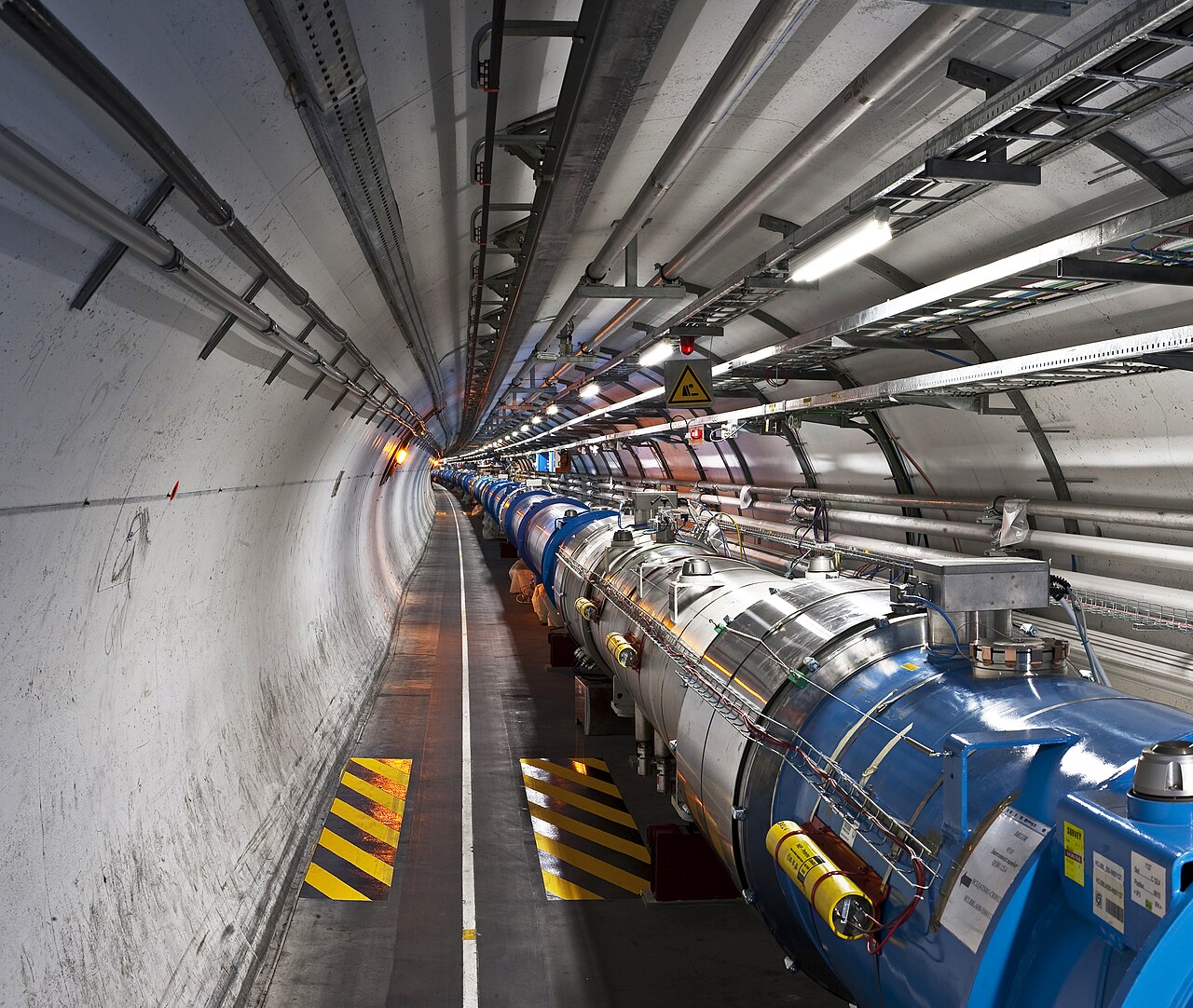
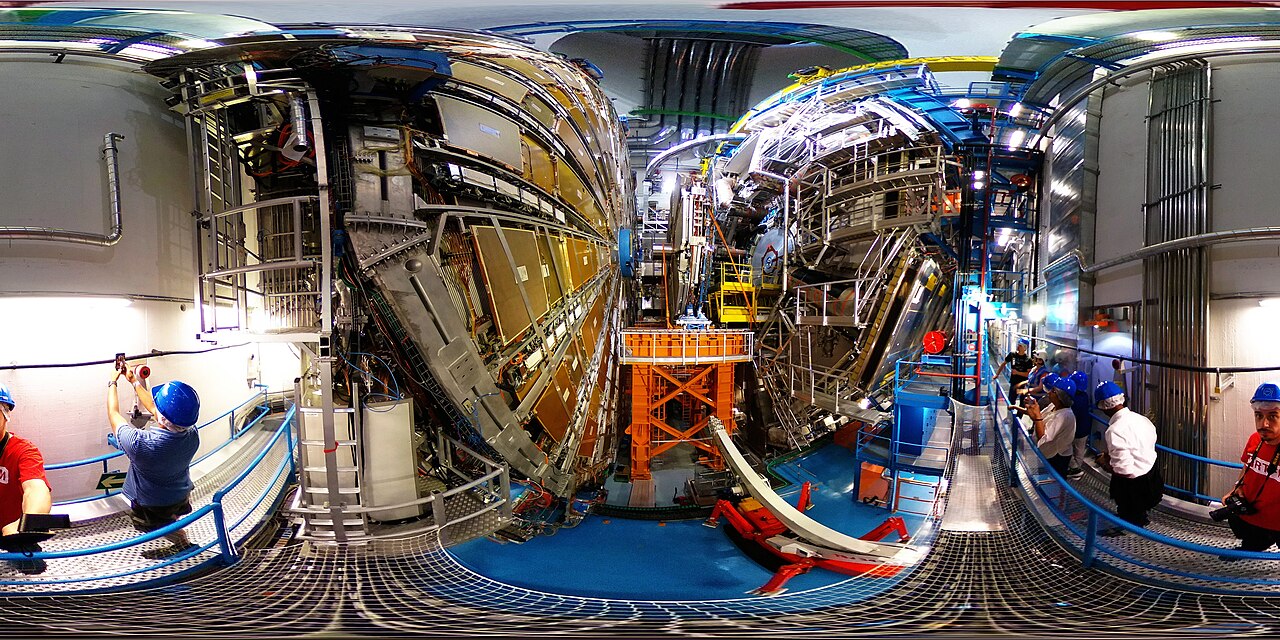
    LHC magnets in the tunnel
    LHC magnets in the tunnel Maximilien Brice, CERN · CC BY-SA 3.0
    The ATLAS detector
    The ATLAS detector SimonWaldherr · CC BY-SA 4.0
    The CMS detector
    The CMS detector SimonWaldherr · CC BY-SA 4.0
    A 2012 Higgs candidate event
    A 2012 Higgs candidate event CMS Collaboration; Thomas McCauley; Lucas Taylor · CC BY 4.0
    The ALICE detector
    The ALICE detector Johannes Vogel · CC BY-SA 3.0
    The Globe of Science and Innovation
    The Globe of Science and Innovation Simon Cobb · CC0

    By the numbers

    • The LHC ring is 26,659 m around, about 100 m underground. source
    • It uses 1,232 main dipole magnets and 9,593 superconducting magnets in all, cooled to 1.9 K (minus 271.3 C). source
    • Record collision energy: 13.6 TeV for protons, reached in 2022. First beams circulated Sept 10, 2008. source
    • ATLAS and CMS announced the Higgs boson on July 4, 2012; about one collision in a billion makes one. source
    • CERN has 25 member states and 11 associate members; Estonia joined in 2024 and Slovenia in 2025. source
    • 2025 was a record year: ATLAS and CMS each recorded 125.4 inverse femtobarns. source
    • Run 3 ended June 27, 2026; Long Shutdown 3 runs until the High-Luminosity LHC returns in mid-2030. source
    • The proposed FCC-ee would be a 91 km collider costed at 15.3 billion Swiss francs, with data-taking around 2045. source
    • ALICE weighs about 10,000 tonnes and makes matter more than 100,000 times hotter than the Sun's core. source
    • The LHC has discovered 80 particles: the Higgs boson and 79 hadrons, including tetraquarks. source

    How CERN touches the seven

    • Yang–Mills: The strong force (QCD) is a Yang–Mills theory, so every LHC measurement is real-world data on exactly what the mass-gap proof must explain. source
    • Yang–Mills: ALICE collides heavy ions to free quarks and gluons in quark-gluon plasma, the one state that escapes confinement. source
    • Yang–Mills: Exotic hadrons such as tetraquarks show how gluons bind quarks; each is a data point any strong-force solution must reproduce. source
    • Quantum gravity: The LHC hunts extra dimensions, escaping gravitons and microscopic black holes; CMS has now ruled out such black holes below 8.4 to 11.4 TeV. source

    CERN news

    • Jul 24, 2026: All four big LHC experiments saw signs of quark-gluon plasma in light oxygen and neon collisions. source
    • Jun 27–29, 2026: Run 3 ended and the upgrade to the High-Luminosity LHC began. source
    • May 2026: CERN Council adopted the European Strategy update: HL-LHC first, FCC-ee next, go/no-go targeted for 2028. source
    • Apr 12, 2026: CMS ruled out semiclassical microscopic black holes below 8.4–11.4 TeV. source
    • Mar 20, 2026: ALICE found a primordial-plasma flow pattern even in small proton collisions. source
    • Nov 12, 2025: A record proton year: about 14 days sooner than 2024's record. source
    Science · The 100 biggest gains · No politics

    The Hundred.

    The hundred advances that made science, Euclid to gene editing, in order. Ten at a time; filter or search.

    1. c. 300 BC
      Euclid’s ElementsMath

      Axioms and proofs: the template for rigorous reasoning for 2,000 years.

      Read more
    2. c. 250 BC
      Archimedes: buoyancy, levers and piPhysics

      Floating bodies, the lever law and a method that bounds pi.

      Read more
    3. c. 830
      Al-Khwarizmi’s algebraMath

      Systematic solving of equations; gives us the words algebra and algorithm.

      Read more
    4. 1543
      Copernicus puts the Sun at the centerSpace

      Earth becomes a planet moving around the Sun.

      Read more
    5. 1543
      Vesalius maps human anatomyMedicine

      Dissection-based anatomy replaces 1,300 years of guesswork.

      Read more
    6. 1609
      Kepler’s laws of planetary motionSpace

      Planets move in ellipses with exact mathematical rules.

      Read more
    7. 1610
      Galileo’s telescope finds Jupiter’s moonsSpace

      Proof that not everything orbits Earth.

      Read more
    8. 1628
      Harvey describes blood circulationMedicine

      The heart pumps blood around a closed loop.

      Read more
    9. 1637
      Descartes joins algebra and geometryMath

      Coordinates turn shapes into equations.

      Read more
    10. 1665
      Hooke names the cellBiology

      Microscopes reveal the building blocks of life.

      Read more
    11. 1670s
      Newton and Leibniz invent calculusMath

      The mathematics of change behind all modern physics and engineering.

      Read more
    12. 1676
      Leeuwenhoek sees microorganismsBiology

      A hidden living world of bacteria and protists.

      Read more
    13. 1687
      Newton’s Principia: motion and gravityPhysics

      One set of laws for falling apples and orbiting planets.

      Read more
    14. 1735
      Linnaeus classifies living thingsBiology

      Two-part species names and an ordered tree of life.

      Read more
    15. 1774
      Discovery of oxygenChemistry

      The gas that explains burning and breathing.

      Read more
    16. 1789
      Lavoisier: conservation of massChemistry

      Chemistry becomes a quantitative science.

      Read more
    17. 1796
      Jenner’s smallpox vaccineMedicine

      The first vaccine, and the road to wiping out smallpox.

      Read more
    18. 1800
      Volta’s batteryPhysics

      The first steady electric current.

      Read more
    19. 1808
      Dalton’s atomic theoryChemistry

      Matter is made of atoms that combine in fixed ratios.

      Read more
    20. 1820s
      Carnot founds thermodynamicsPhysics

      The limits of every heat engine, from steam to rockets.

      Read more
    21. 1831
      Faraday’s electromagnetic inductionPhysics

      Moving magnets make electricity: the basis of generators and motors.

      Read more
    22. 1838
      Cell theoryBiology

      All living things are made of cells (Schleiden and Schwann).

      Read more
    23. 1840s
      Conservation of energyPhysics

      Energy changes form but is never created or destroyed.

      Read more
    24. 1846
      Ether anesthesia demonstratedMedicine

      Surgery without pain becomes possible.

      Read more
    25. 1847
      Semmelweis: handwashing prevents infectionMedicine

      Clean hands cut deaths in maternity wards.

      Read more
    26. 1854
      Snow traces cholera to a water pumpMedicine

      The birth of epidemiology.

      Read more
    27. 1859
      Darwin’s evolution by natural selectionBiology

      How all life on Earth came to be.

      Read more
    28. 1865
      Mendel’s laws of inheritanceBiology

      Traits pass down in discrete units, later called genes.

      Read more
    29. 1865
      Maxwell’s equationsPhysics

      Electricity, magnetism and light are one force.

      Read more
    30. 1867
      Lister’s antiseptic surgeryMedicine

      Sterile surgery slashes post-operative deaths.

      Read more
    31. 1869
      Mendeleev’s periodic tableChemistry

      Order among the elements, with gaps that predicted new ones.

      Read more
    32. 1870s
      Germ theoryMedicine

      Microbes cause disease (Pasteur and Koch).

      Read more
    33. 1882
      Koch identifies the tuberculosis bacteriumMedicine

      The cause of the deadliest disease of the age.

      Read more
    34. 1887
      Hertz produces radio wavesPhysics

      Maxwell confirmed, and wireless communication begins.

      Read more
    35. 1895
      Roentgen discovers X-raysPhysics

      Seeing inside the body without surgery.

      Read more
    36. 1896
      Becquerel discovers radioactivityPhysics

      Atoms are not unchangeable.

      Read more
    37. 1897
      Thomson discovers the electronPhysics

      The first subatomic particle.

      Read more
    38. 1900
      Planck’s quantum hypothesisPhysics

      Energy comes in packets: the start of quantum physics.

      Read more
    39. 1901
      Landsteiner’s blood groupsMedicine

      Safe blood transfusions.

      Read more
    40. 1905
      Einstein’s special relativity and light quantaPhysics

      Space and time are relative; light is made of particles.

      Read more
    41. 1909
      Haber–Bosch ammonia synthesisChemistry

      Fertilizer from air now feeds billions.

      Read more
    42. 1911
      Rutherford’s atomic nucleusPhysics

      Atoms are mostly empty space around a tiny nucleus.

      Read more
    43. 1912
      Wegener proposes continental driftEarth

      Continents move, later confirmed as plate tectonics.

      Read more
    44. 1915
      Einstein’s general relativityPhysics

      Gravity is the curvature of spacetime.

      Read more
    45. 1921
      Insulin isolatedMedicine

      Diabetes stops being a death sentence.

      Read more
    46. 1920s
      Quantum mechanicsPhysics

      The rules of atoms (Heisenberg, Schrodinger and others).

      Read more
    47. 1928
      Fleming discovers penicillinMedicine

      The first antibiotic.

      Read more
    48. 1929
      Hubble: the universe is expandingSpace

      Galaxies race apart, pointing back to a beginning.

      Read more
    49. 1931
      Godel’s incompleteness theoremsMath

      Some true statements can never be proved.

      Read more
    50. 1932
      Antimatter discoveredPhysics

      The positron, the first antiparticle.

      Read more
    51. 1930s
      Electron microscopePhysics

      Seeing viruses and molecules.

      Read more
    52. 1936
      Turing’s theory of computationComputing

      The universal machine behind every computer.

      Read more
    53. 1938
      Nuclear fission discoveredPhysics

      Splitting atoms releases enormous energy.

      Read more
    54. 1940s
      Penicillin mass-producedMedicine

      Antibiotics reach millions of patients.

      Read more
    55. 1947
      The transistorComputing

      The switch inside every chip.

      Read more
    56. 1948
      Shannon’s information theoryComputing

      The mathematics of every digital message.

      Read more
    57. 1949
      Radiocarbon datingEarth

      Clocks in carbon date the last 50,000 years.

      Read more
    58. 1952
      Miller–Urey experimentBiology

      Building blocks of life from simple chemistry.

      Read more
    59. 1953
      DNA double helixBiology

      The structure that stores and copies genetic information.

      Read more
    60. 1955
      Salk polio vaccineMedicine

      The end of polio epidemics in much of the world.

      Read more
    61. 1957
      Sputnik opens the space ageSpace

      The first artificial satellite.

      Read more
    62. 1958
      Integrated circuitComputing

      Many transistors on one chip.

      Read more
    63. 1960
      The laserPhysics

      Coherent light for surgery, fiber optics and fusion.

      Read more
    64. 1961
      Genetic code crackedBiology

      How DNA spells out proteins.

      Read more
    65. 1964
      Cosmic microwave background foundSpace

      The afterglow of the Big Bang.

      Read more
    66. 1960s
      Plate tectonics confirmedEarth

      Moving plates explain earthquakes, volcanoes and mountains.

      Read more
    67. 1960s
      Green Revolution crop breedingBiology

      High-yield crops avert mass famine.

      Read more
    68. 1967
      Pulsars discoveredSpace

      Spinning neutron stars as cosmic clocks.

      Read more
    69. 1969
      Apollo 11 Moon landingSpace

      Humans walk on another world.

      Read more
    70. 1972
      Recombinant DNABiology

      Genetic engineering begins.

      Read more
    71. 1970s
      Standard Model of particle physicsPhysics

      The most precisely tested theory in science.

      Read more
    72. 1970s
      Public-key cryptographyComputing

      Secure communication between strangers, the basis of online trust.

      Read more
    73. 1977
      DNA sequencingBiology

      Reading the genetic code letter by letter (Sanger).

      Read more
    74. 1978
      First IVF babyMedicine

      In vitro fertilization helps millions of families.

      Read more
    75. 1980
      Smallpox eradicatedMedicine

      The first human disease wiped out.

      Read more
    76. 1983
      Polymerase chain reactionBiology

      Copying DNA millions of times in hours.

      Read more
    77. 1983
      HIV identifiedMedicine

      The cause of AIDS found, opening the way to treatment.

      Read more
    78. 1989
      World Wide WebComputing

      Linked information for everyone.

      Read more
    79. 1990
      Hubble Space Telescope launchedSpace

      The sharpest view of the universe yet.

      Read more
    80. 1994
      Shor’s quantum factoring algorithmComputing

      Quantum computers could break today’s encryption.

      Read more
    81. 1995
      First exoplanet around a Sun-like starSpace

      Planets are common across the galaxy.

      Read more
    82. 1996
      Dolly the cloned sheepBiology

      An adult cell can be reprogrammed into a whole animal.

      Read more
    83. 1990s
      Antiretroviral therapy for HIVMedicine

      HIV becomes a manageable condition.

      Read more
    84. 1998
      Accelerating expansion of the universeSpace

      Dark energy makes up most of the cosmos.

      Read more
    85. 2003
      Human Genome Project completedBiology

      The full human genetic instruction set.

      Read more
    86. 2006
      Induced pluripotent stem cellsBiology

      Adult cells reset to an embryonic-like state.

      Read more
    87. 2007
      Deep learning breakthroughs beginComputing

      Neural networks start learning from huge data.

      Read more
    88. 2012
      Higgs boson discoveredPhysics

      The particle that gives others mass.

      Read more
    89. 2012
      CRISPR gene editingBiology

      Precise, cheap editing of DNA.

      Read more
    90. 2013
      Cancer immunotherapy provenMedicine

      Checkpoint inhibitors turn the immune system on tumors.

      Read more
    91. 2015
      Gravitational waves detectedSpace

      Hearing black holes collide.

      Read more
    92. 2015
      Orbital rocket booster landsSpace

      Reusable rockets cut the cost of reaching space.

      Read more
    93. 2016
      AlphaGo defeats a world championComputing

      Machines master intuition-heavy games.

      Read more
    94. 2019
      First image of a black holeSpace

      The shadow of M87’s black hole.

      Read more
    95. 2020
      AlphaFold predicts protein structuresBiology

      A 50-year problem in biology largely solved.

      Read more
    96. 2020
      mRNA vaccinesMedicine

      Vaccines designed in days, given to billions.

      Read more
    97. 2021
      James Webb Space Telescope launchedSpace

      Seeing the first galaxies.

      Read more
    98. 2022
      Fusion ignition at the National Ignition FacilityPhysics

      More energy out of a fusion reaction than the lasers put in.

      Read more
    99. 2022
      DART shifts an asteroid’s orbitSpace

      Planetary defense works.

      Read more
    100. 2023
      CRISPR therapy approved for sickle cell diseaseMedicine

      The first approved gene-editing cure.

      Read more

    NASA · 72 free resources · every link checked live

    Every NASA resource, one door.

    The data, archives, images, tools, jobs, grants and press channels NASA opens to anyone, at no cost, sorted the way the people inside NASA sort them. Open a group.

    Data and archivesThe raw science, free to anyone16
    1. NASA Open Data PortalThousands of NASA datasets in one catalog
    2. Planetary Data SystemEvery planetary mission's archived data, from Mariner to Perseverance
    3. EarthdataAll of NASA's Earth science data, with free login
    4. NSSDCAThe Space Science Data Coordinated Archive: master catalog of every spacecraft
    5. MASTHubble, JWST, TESS and Kepler data archive
    6. Chandra Data ArchiveEvery Chandra X-ray observation, run for NASA by the Smithsonian
    7. IRSAInfrared archive: Spitzer, WISE, 2MASS
    8. NEDThe NASA/IPAC Extragalactic Database: every known galaxy
    9. Exoplanet ArchiveEvery confirmed exoplanet, with its data
    10. CDAWebSpace physics data from dozens of heliophysics missions
    11. JPL HorizonsPosition of any body in the solar system at any time
    12. Small-Body DatabaseEvery known asteroid and comet
    13. CNEOSNear-Earth objects, close approaches and impact risk
    14. GES DISCAtmosphere, climate and hydrology data
    15. PO.DAACOcean data from space
    16. LP DAACLand data: MODIS, Landsat-derived products
    Papers and researchWhat NASA has written down8
    1. NASA Technical Reports ServerEvery NASA technical report, paper and presentation since 1915
    2. ADSThe astrophysics literature database, funded by NASA
    3. NASA ScienceEvery science mission and discovery, by topic
    4. NASA HistoryOfficial histories, oral histories and archives
    5. STI ProgramHow NASA publishes and preserves its research
    6. SpinoffWhat NASA technology became on Earth, every year since 1976
    7. TechPortEvery NASA technology project, searchable
    8. MissionsEvery mission, past, present and planned
    Images, video and soundPublic domain, for anyone to use10
    1. NASA Image and Video LibraryOver 140,000 images, videos and audio files, searchable
    2. PhotojournalEvery planetary image JPL has released
    3. Astronomy Picture of the DayOne picture and one explanation, every day since 1995
    4. NASA+Live launches, documentaries and series, free with no ads
    5. NASA LiveLive launches, spacewalks and briefings
    6. Scientific Visualization StudioData-driven animations of Earth and space
    7. Webb imagesJWST's releases and science
    8. HubbleSiteHubble's images and news
    9. Perseverance raw imagesEvery photo the rover sends, as it arrives
    10. Media usage guidelinesHow you may use NASA images, video and the logo
    Tools, apps and APIsBuild with NASA10
    1. NASA APIsAPOD, Mars rover photos, asteroids, Earth imagery and more, one free key
    2. NASA's Eyes3D visualizations of the solar system, Earth and exoplanets in your browser
    3. WorldviewToday's satellite imagery of Earth, interactive
    4. Solar System TreksInteractive maps of Mars, the Moon, Vesta and more
    5. Software CatalogNASA's own software, free to download
    6. NASA on GitHubOpen-source code from across the agency
    7. Spot the StationWhen the space station passes over your town
    8. NASA AppThe official app for phone, tablet and TV
    9. Citizen ScienceProjects anyone can join and get credit on
    10. Learning resourcesLessons, activities and games for every age
    Spacecraft, launches and the stationWhere everything is right now8
    1. Launch scheduleEvery upcoming NASA launch
    2. International Space StationThe station, its crew and its research
    3. ArtemisThe return to the Moon
    4. MarsEverything Mars: missions, weather, maps
    5. PerseveranceThe rover, its instruments and its samples
    6. Solar SystemEvery planet, moon and small body
    7. The SunHeliophysics missions and space weather
    8. The UniverseAstrophysics missions and discoveries
    Working with NASAJobs, grants, patents, contracts8
    1. NASA CareersHow to work at NASA, and the openings
    2. NASA on USAJobsEvery open federal NASA job
    3. NASA InternshipsPaid internships for students
    4. NSPIRESEvery NASA research solicitation and how to propose
    5. SBIR/STTRSmall-business research funding from NASA
    6. Technology TransferLicense NASA patents, many free for startups
    7. SAM.govRegister to bid on NASA contracts
    8. Doing business with NASAProcurement, forecasts and small-business help
    News and pressStraight from the source6
    1. NASA NewsEvery release and feature
    2. All newsThe full feed, newest first
    3. Brand CenterLogos, guidelines and media rules
    4. Media resourcesPress contacts, credentials and b-roll
    5. PodcastsHouston We Have a Podcast, Curious Universe and more
    6. NASA BlogsMission blogs, updated by the teams
    Visit NASAIn person, free or nearly6
    1. Centers and facilitiesAll ten centers and where they are
    2. Kennedy Space Center Visitor ComplexLaunch viewing and the Saturn V
    3. JPL toursFree public tours of the Jet Propulsion Laboratory
    4. Johnson Space CenterMission control and astronaut training
    5. GoddardWhere Hubble and Webb were built and are run
    6. National Air and Space MuseumThe Smithsonian's collection, free

    Nearly all NASA images, video and data are in the public domain; the NASA logo and astronaut likenesses are not. The Media usage guidelines above say exactly what you may do.

    CERN · 56 free resources · every link checked live

    What the people at CERN actually use.

    The data, software, lectures, media and tools that CERN staff, contractors, students, teachers and journalists use every day, and that anyone can use at no cost. Open a group.

    Open data and resultsWhat the physicists actually work from, free to anyone13
    1. CERN Open Data PortalPetabytes of real collision data and the software to analyze it
    2. ATLAS Open DataReal ATLAS data and tutorials for students
    3. CMS Open DataHow CMS releases its data
    4. HEPDataThe numbers behind published particle-physics results, downloadable
    5. INSPIRE-HEPThe literature database every particle physicist uses
    6. CERN Document ServerPapers, reports, photos and videos from CERN since 1954
    7. ZenodoOpen research repository run by CERN, any field, free DOI for your data
    8. arXiv hep-exExperimental particle-physics preprints, daily
    9. arXiv hep-phPhenomenology preprints, daily
    10. arXiv hep-thTheory preprints, daily
    11. Particle Data Group ReviewThe free reference book on every known particle, used everywhere
    12. Open Hardware RepositoryElectronics designs from CERN and others, open licence
    13. Kaggle: TrackMLCERN's public machine-learning challenge on real detector data
    Software CERN built and gives awayInstalled on laptops from Geneva to Boulder9
    1. ROOTThe data-analysis framework behind most LHC results, free and open
    2. Geant4Simulation of particles passing through matter, used by CERN, NASA and hospitals
    3. RucioScientific data management across sites, built at CERN
    4. CernVM-FSThe file system that delivers software to the grid
    5. IndicoCERN's event and conference management software, open source
    6. InvenioCERN's open-source digital repository framework
    7. REANAReusable analysis platform from CERN
    8. EOSCERN's open-source disk storage system
    9. FLUKAParticle transport and interaction code from CERN, free for research
    Learning, from high school to postdocLectures, programmes and reading, all free10
    1. Indico at CERNPublic lectures, seminars and conferences, with recordings
    2. CERN VideosThe video archive, from lectures to launches
    3. CERN Science: physicsPlain-language explainers of the Standard Model and beyond
    4. Beamline for SchoolsHigh-school teams win a week of beam time at CERN
    5. CERN teacher programmesFree residential courses for physics teachers
    6. CERN CourierThe international magazine of high-energy physics, free online
    7. Quanta Magazine: physicsFree long-form reporting read across the lab
    8. CERN timelinesThe lab's history, year by year
    9. CERN historyHow the lab came to be, 1954 to now
    10. CERN LibraryCatalogue and services, much of it open
    Media, images and visitingWhat journalists and visitors use7
    1. CERN NewsThe lab's own news and press releases
    2. CERN Press OfficeFor journalists: accreditation, contacts, visits
    3. CERN imagesOfficial image collections, Creative Commons licensed
    4. Wikimedia Commons: CERNThousands of free-licensed photos of the lab
    5. Visit CERNFree guided tours and the Science Gateway, booking required
    6. CERN exhibitionsPermanent free exhibitions in Geneva
    7. CERN Science GatewayFree admission to the new science centre
    Working at CERNJobs, placements and the networks around the lab7
    1. CERN CareersEvery job, fellowship, studentship and technician post, with pay listed
    2. CERN Summer Student programmePaid summer placements with lectures
    3. CERN Alumni NetworkFree to join for anyone who worked or studied at CERN
    4. CERN openlabIndustry and CERN computing collaboration
    5. CERN Knowledge TransferHow CERN technology reaches companies and hospitals
    6. IdeaSquareCERN's innovation space for students and startups
    7. CERN and Society FoundationSupports education and outreach projects
    Live, right nowThe screens the control room watches7
    1. LHC Page 1The live accelerator status screen every operator watches
    2. LHC scheduleThe published run schedule
    3. ATLASThe experiment's public site, with event displays and open data
    4. CMSThe experiment's public site
    5. ALICEThe heavy-ion experiment
    6. LHCbThe beauty-quark experiment
    7. CERN Data CentreHow the computing works, with public numbers
    Needs a CERN accountListed so you know what is inside the badge line3
    1. CERNBoxCloud storage for CERN users (needs a CERN account)
    2. SWANNotebooks on CERN's cloud (needs a CERN account)
    3. CERN TWikiCollaboration wikis (most pages need a CERN login)
    Carnegie · Pittsburgh and beyond

    Study the seven for free.

    Sign up once and get lectures, databases and courses from Carnegie Mellon, its libraries, the Carnegie Library of Pittsburgh and Carnegie Science. Every link checked Oct 24, 2026.

    The physics and the math · Six universities · 28 pinpoint links, every one checked live

    Cornell, Denver, Colorado, Pitt, Duquesne and Chicago.

    Only the departments, labs and archives that bear on the thirteen doors: physics, mathematics, astronomy, the accelerators and the observatories. Nothing else.

    Cornell University

    Ithaca, New York

    University of Denver

    Denver, Colorado

    University of Colorado

    Boulder, Denver, Colorado Springs

    University of Pittsburgh

    Pittsburgh, Pennsylvania

    Duquesne University

    Pittsburgh, Pennsylvania

    University of Chicago

    Chicago, Illinois
    The library · 122 titles

    Every book, film, show, song and game Elon has named.

    Compiled from Musk’s own posts, interviews and podcasts as collected by public trackers. Each title links to an Amazon search for it.

    Books — Science Fiction and Fantasy12
    1. The Hitchhiker's Guide to the Galaxy — Douglas Adams. Credited with getting Musk through a teenage existential crisis; Don't Panic was on the Falcon Heavy Roadster's screen.Find on Amazon
    2. Foundation series — Isaac Asimov. Worth reading Asimov's Foundation.Find on Amazon
    3. The Moon Is a Harsh Mistress — Robert Heinlein.Find on Amazon
    4. Stranger in a Strange Land — Robert Heinlein.Find on Amazon
    5. Dune and the full Dune series (Dune Messiah, Children of Dune, God Emperor of Dune, Heretics of Dune, Chapterhouse: Dune) — Frank Herbert. Dune Series by Herbert [is] brilliant.Find on Amazon
    6. The Culture series — Iain M. Banks, specifically: Consider Phlebas, The Player of Games, Use of Weapons, The State of the Art, Excession, Inversions, Look to Windward (Pantheon level), Matter, Surface Detail (especially Surface Detail), The Hydrogen Sonata.Find on Amazon
    7. A Song of Ice and Fire — George R. R. Martin: A Game of Thrones, A Clash of Kings, A Storm of Swords, A Feast for Crows, A Dance with Dragons. Best books in recent years imo are Iain Banks & George Martin.Find on Amazon
    8. The Lord of the Rings — J. R. R. Tolkien (childhood favorite, per The New Yorker 2009).Find on Amazon
    9. The Machine Stops — E. M. Forster.Find on Amazon
    10. I Have No Mouth, and I Must Scream — Harlan Ellison (Musk said it gives nightmares).Find on Amazon
    11. Daemon — Daniel Suarez. Daemon is a great read.Find on Amazon
    12. Dark City — Frank Lauria.Find on Amazon

    Sources compiled by:

    Books — Artificial Intelligence7
    1. Superintelligence — Nick Bostrom. Worth reading Superintelligence by Bostrom.Find on Amazon
    2. Our Final Invention — James Barrat.Find on Amazon
    3. Life 3.0 — Max Tegmark.Find on Amazon
    4. Human Compatible — Stuart Russell. Musk called Russell great.Find on Amazon
    5. The AI Revolution (Wait But Why essay) — Tim Urban.Find on Amazon
    6. What We Owe the Future — William MacAskill (Musk said it matches Musk’s philosophy).Find on Amazon
    7. The Master Algorithm — Pedro Domingos (listed by some trackers; weaker sourcing).Find on Amazon

    Sources compiled by:

    Books — Science, Engineering and Space6
    1. Ignition! An Informal History of Liquid Rocket Propellants — John D. Clark.Find on Amazon
    2. Structures: Or Why Things Don't Fall Down — J. E. Gordon.Find on Amazon
    3. Rocket Propulsion Elements / Huzel & Wang, Design of Liquid Propellant Rocket Engines (named with Ignition!).Find on Amazon
    4. If the Universe Is Teeming with Aliens... Where Is Everybody? — Stephen Webb.Find on Amazon
    5. The Big Picture — Sean Carroll.Find on Amazon
    6. The Skeptics' Guide to the Universe — Steven Novella and team.Find on Amazon

    Sources compiled by:

    Books — Biography10
    1. Benjamin Franklin: An American Life — Walter Isaacson (Franklin is one of my heroes).Find on Amazon
    2. Einstein: His Life and Universe — Walter Isaacson.Find on Amazon
    3. Steve Jobs — Walter Isaacson.Find on Amazon
    4. Howard Hughes: His Life and Madness — Barlett and Steele.Find on Amazon
    5. Catherine the Great: Portrait of a Woman — Robert K. Massie.Find on Amazon
    6. Genghis Khan and the Making of the Modern World — Jack Weatherford.Find on Amazon
    7. Masters of Doom — David Kushner.Find on Amazon
    8. American Caesar: Douglas MacArthur — William Manchester.Find on Amazon
    9. My Inventions — Nikola Tesla (autobiography).Find on Amazon
    10. A Woman Makes a Plan — Maye Musk (Elon’s mother). My Mom wrote a book.Find on Amazon

    Sources compiled by:

    Books — History and War9
    1. The Story of Civilization — Will and Ariel Durant, especially Vol. 1 Our Oriental Heritage, Vol. 2 The Life of Greece (incredible) and Vol. 11 The Age of Napoleon (an amazing book).Find on Amazon
    2. The Guns of August — Barbara Tuchman.Find on Amazon
    3. Storm of Steel — Ernst Junger (audiobook).Find on Amazon
    4. The Wages of Destruction — Adam Tooze.Find on Amazon
    5. The Gallic Wars — Julius Caesar (audiobook).Find on Amazon
    6. The Fifteen Decisive Battles of the World — Edward Creasy.Find on Amazon
    7. The Encyclopedia of Military History — Dupuy and Dupuy.Find on Amazon
    8. Merchants of Doubt — Oreskes and Conway. I recommend people read a book called Merchants of Doubt.Find on Amazon
    9. Twelve Against the Gods — William Bolitho.Find on Amazon

    Sources compiled by:

    Books — Business, Economics and Politics10
    1. Zero to One — Peter Thiel (Musk blurb on the cover).Find on Amazon
    2. Screw Business as Usual — Richard Branson.Find on Amazon
    3. The Wealth of Nations — Adam Smith. Adam Smith FTW obv.Find on Amazon
    4. Das Kapital — Karl Marx (read at 14, cross-checked against the German).Find on Amazon
    5. The Road to Serfdom — F. A. Hayek (audiobook).Find on Amazon
    6. The Capitalist Manifesto — Johan Norberg.Find on Amazon
    7. What's Our Problem? — Tim Urban.Find on Amazon
    8. The Parasitic Mind — Gad Saad. Great book.Find on Amazon
    9. Bad Therapy — Abigail Shrier.Find on Amazon
    10. Atlas Shrugged — Ayn Rand (on several tracker lists).Find on Amazon

    Sources compiled by:

    Books — Other Fiction and Plays5
    1. Waiting for Godot — Samuel Beckett.Find on Amazon
    2. The Fault in Our Stars — John Green.Find on Amazon
    3. The Iliad — Homer (audiobook).Find on Amazon
    4. Lying — Sam Harris. Lots of good reasons not to lie!Find on Amazon
    5. Shakespeare — has quoted The Tempest; a favorite-play mention reported by Benzinga.Find on Amazon

    Sources compiled by: Read This Twice, The Ways To Wealth, Shortform, AI Fire, Bookmarked, RT Book Reviews

    Movies17
    1. Star Wars (1977, A New Hope) — Musk’s all-time favorite; the first film Musk saw in a theater, around age six (Full Send podcast).Find on Amazon
    2. Parasite (2019) — Musk’s favorite film of 2019.Find on Amazon
    3. Your Name (2016) — Musk’s favorite anime (2026 Q&A).Find on Amazon
    4. Princess Mononoke (1997).Find on Amazon
    5. Spirited Away (2001).Find on Amazon
    6. Ghost in the Shell (1995).Find on Amazon
    7. Moonraker (1979) — James Bond.Find on Amazon
    8. The Spy Who Loved Me (1977) — James Bond; Musk bought the Lotus Esprit submarine car from it.Find on Amazon
    9. The Lego Movie (2014).Find on Amazon
    10. Dumb and Dumber (1994).Find on Amazon
    11. Office Space (1999). An awesome movie.Find on Amazon
    12. Blade Runner (1982).Find on Amazon
    13. Spaceballs (1987).Find on Amazon
    14. Top Gun (1986) — a great movie; Musk looked forward to Top Gun: Maverick (2022).Find on Amazon
    15. Monty Python's Life of Brian (1979) — via Musk’s song pick.Find on Amazon
    16. Team America: World Police (2004) — via Musk’s song pick.Find on Amazon
    17. Iron Man 2 (2010) — Musk has a cameo; Tony Stark was partly modeled on Musk.Find on Amazon

    Sources compiled by: Far Out Magazine, Benzinga, Memorizer, Fliist

    TV Shows and Anime Series12
    1. Black Mirror — Musk’s favorite Netflix series (2019).Find on Amazon
    2. Death Note — favorite anime; was asked Light vs. L.Find on Amazon
    3. Neon Genesis Evangelion.Find on Amazon
    4. Fullmetal Alchemist.Find on Amazon
    5. Rick and Morty — kinda disgusting, but my boys and I love it.Find on Amazon
    6. Nathan for You — worth watching; posted a Dumb Starbucks mug.Find on Amazon
    7. Westworld (ex-wife Talulah Riley appeared in it).Find on Amazon
    8. Silicon Valley.Find on Amazon
    9. South Park and The Simpsons (Musk has appeared on both).Find on Amazon
    10. Vikings — blamed a hairstyle on watching too many episodes.Find on Amazon
    11. Family Guy — joked that a Family Guy compilation was Musk’s favorite movie of 2024.Find on Amazon
    12. XKCD (web comic) — listed alongside Musk’s favorite shows.Find on Amazon

    Sources compiled by: Inverse — Rick and Morty, Inverse — Nathan for You, ComicBook.com, Netflix Junkie, The Things

    Songs and Music19
    1. Fly Me to the Moon — Frank Sinatra (KCRW Guest DJ, 2011).Find on Amazon
    2. Always Look on the Bright Side of Life — Monty Python (KCRW).Find on Amazon
    3. America, F*** Yeah — Team America (KCRW).Find on Amazon
    4. Con te partiro — Andrea Bocelli: a reminder that the world is a beautiful place.Find on Amazon
    5. Santa Claus Is Coming to Town — the song Musk whistles most.Find on Amazon
    6. Ave Maria and Bach's Air (on piano) — with Con te partiro, three of my all-time favorites (X, 2023).Find on Amazon
    7. Flesh Without Blood and Kill V. Maim — Grimes.Find on Amazon
    8. Everything Is Awesome — The Lego Movie.Find on Amazon
    9. Weird Al Yankovic — a stated favorite artist.Find on Amazon
    10. What a Wonderful World — Louis Armstrong: one of the all-time best songs.Find on Amazon
    11. Ring of Fire — Johnny Cash (Musk’s favorite Johnny Cash song).Find on Amazon
    12. Mein Herz brennt — Rammstein: best boss battle song ever.Find on Amazon
    13. (I Just) Died in Your Arms — Cutting Crew.Find on Amazon
    14. Planet Claire — The B-52's.Find on Amazon
    15. Bohemian Rhapsody — Queen.Find on Amazon
    16. Lithium — Nirvana.Find on Amazon
    17. Short Shorts — The Royal Teens.Find on Amazon
    18. Losing It — FISHER.Find on Amazon
    19. Adagio for Strings — Tiesto.Find on Amazon

    Sources compiled by: KCRW, Entrepreneur, Musk on X, NME, Fliist — Music, Hypebeast

    Video Games15
    1. The Battle of Polytopia — way better than chess; deleted it for using too many brain cycles.Find on Amazon
    2. Elden Ring — candidate for the best game ever, top five for sure (Lex Fridman, 2023).Find on Amazon
    3. Diablo IV — top-ranked player; also Diablo Immortal.Find on Amazon
    4. Overwatch — amazing; mained Soldier: 76.Find on Amazon
    5. Hearthstone — Musk plays it with the kids.Find on Amazon
    6. Deus Ex (original).Find on Amazon
    7. Mass Effect 2 — one of the best games ever.Find on Amazon
    8. BioShock.Find on Amazon
    9. Fallout series.Find on Amazon
    10. Half-Life 2.Find on Amazon
    11. Civilization series.Find on Amazon
    12. Warcraft.Find on Amazon
    13. Kerbal Space Program — awesome.Find on Amazon
    14. The Ancient Art of War (1984).Find on Amazon
    15. Blastar — the game Musk wrote and sold at 12.Find on Amazon

    Sources compiled by: Fortune, Business Insider India, SlashGear, Inverse, Sifted

    Musk has posted many thousands of times on X since 2010; no public record captures every passing mention. This list covers every title collected by the major trackers above plus Musk’s named interview picks. Items marked as weaker sourcing appear on tracker lists without a located original post.

    The Pursuit · Open to everyone

    Every breakthrough. Every wall.

    Share a win or a dead end on any of the seven. Nobody solves these alone, and nobody should hit the wall alone either.

    Arcade · Earth to Mars

    Don’t Panic.

    Fly the space roadster from Earth orbit to the Mars landing pads. Dodge the asteroids and satellite trains, then hop across the drifting booster stages. On a computer, use the arrow keys. On a phone, swipe on the game or use the arrow pad under it.

    Short film · The ride (3 min 22 s)

    Starman picks up an alien passenger in SpaceX’s real Roadster photo. They discuss battery life entirely in Klingon, with subtitles in English or any of 12 other languages, then the radio comes on and they ride out the whole song. Original music.

    Leonardo da Vinci →

    Also play: Crown of Codex →

    Score 0Best 0Lives 3Level 1
    1. 2018

      “Do You Trust This Computer?”

      “Rapidly heading towards digital superintelligence that far exceeds any human.”

      Musk also said it would happen within Musk’s lifetime, 100%, and warned that a small group with godlike digital superintelligence could take over the world.

    2. April 2023

      Tucker Carlson

      Musk said Larry Page wanted a digital super-intelligence, basically a digital god, as soon as possible.

    3. November 2019

      Lex Fridman

      “The point at which we have digital superintelligence”

      is, Musk said, when we pass the singularity. Musk also suggested a third layer of the brain where digital superintelligence lies.

      Source: Inverse
    4. TED interview

      TED

      Musk said the danger is that artificial general intelligence, or digital superintelligence, decouples from the collective human will.

      Source: Nasdaq
    5. 2025

      Event remarks

      “I think we’re quite close to digital superintelligence.”

      Musk defined it as smarter than any human at anything.

      Source: OfficeChai · Video: YouTube
    6. Late 2025

      Conversation

      Musk repeated an earlier line that humans are the biological bootloader for digital superintelligence.

      Source: Tiger
    Independent archive. This site is not affiliated with, endorsed by, or operated by Elon Musk or any Musk company. Statements are summarized from the linked reporting; follow each source for full context.
    SpaceX · Public Domain Archive

    Every frame,
    free forever.

    Every photo and video SpaceX released into the public domain, pulled live from the Wikimedia Commons record. Tap any frame for full resolution.
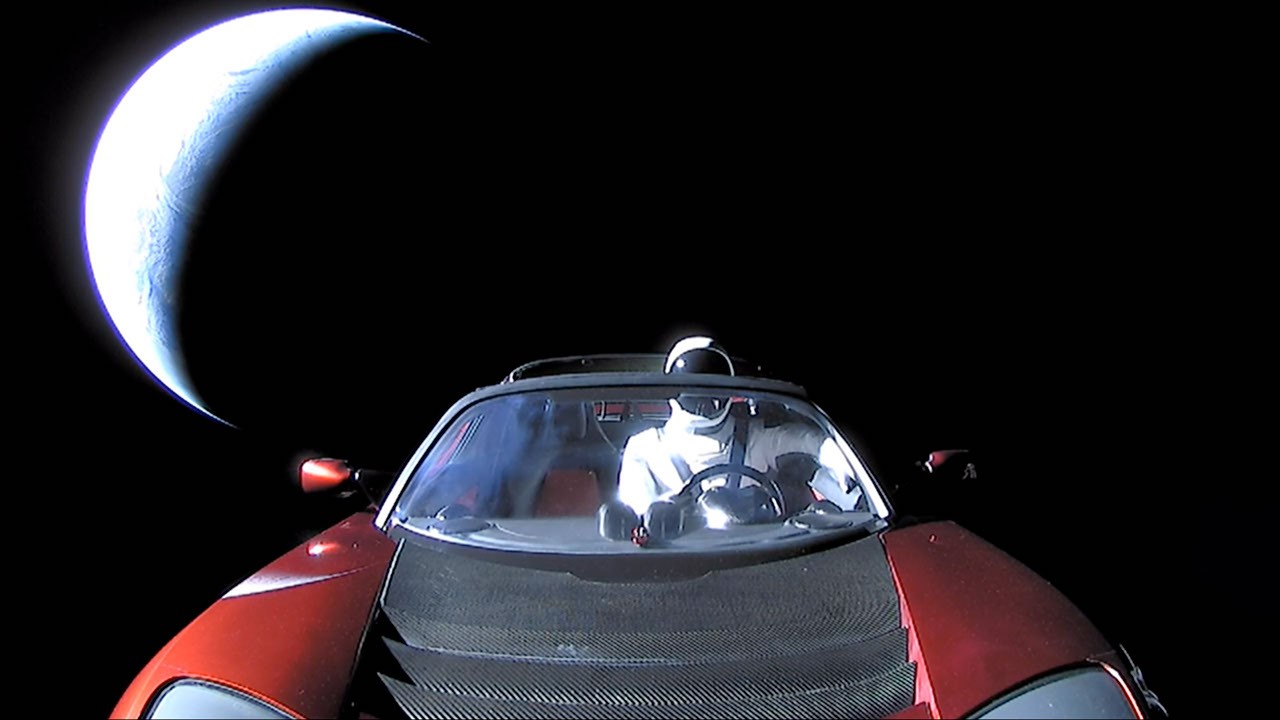
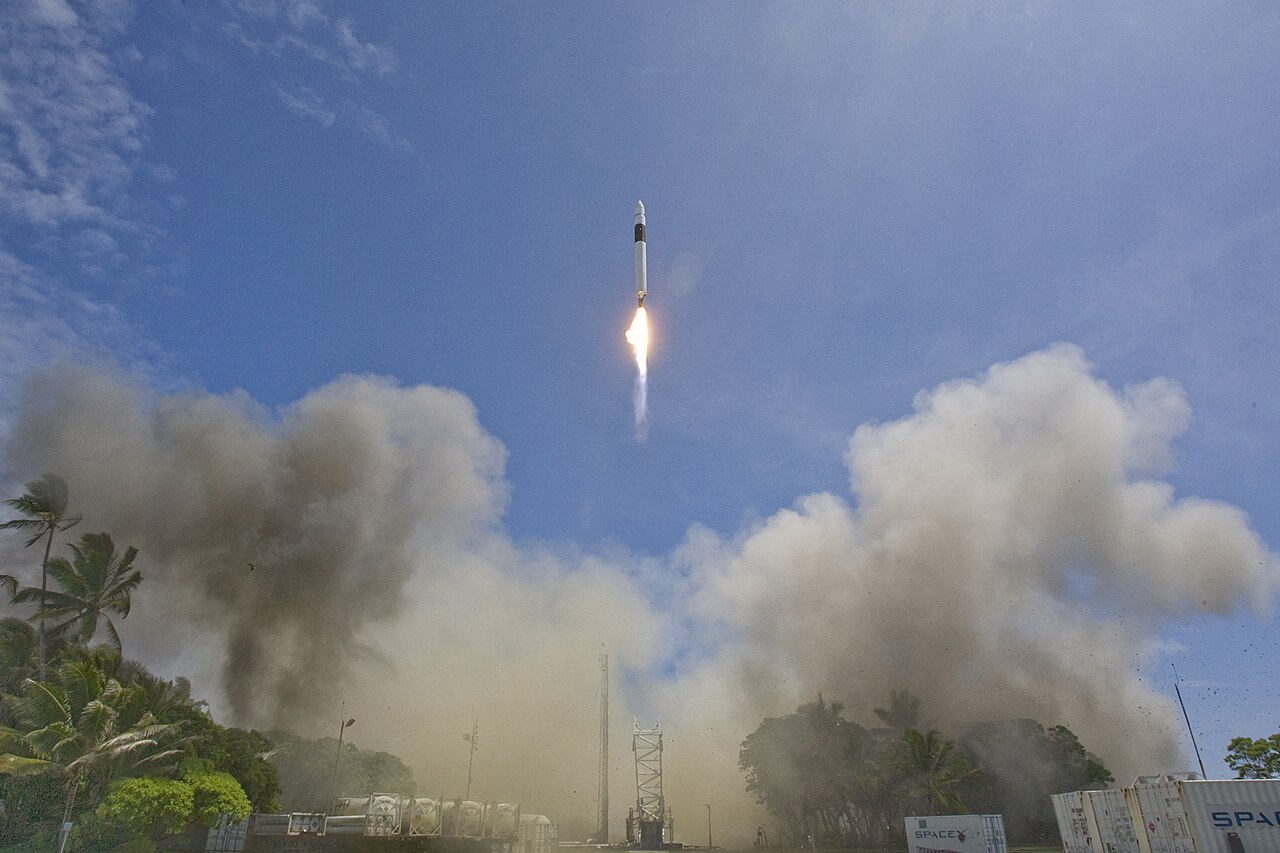
    0Frames loaded
    0Photos
    0Videos
    —Span
    Starman in a Tesla Roadster with Earth behind it
    StarmanTesla Roadster · Falcon Heavy · Feb 6, 2018
    Falcon 1 lifting off from Omelek Island
    Falcon 1First private liquid-fuel rocket to orbit · Sept 28, 2008
    Natal chart

    Elon Musk’s full birth chart →

    Leonardo da Vinci’s →

    Yours, free: your chart, then a night at one table with Leonardo and Elon, on the three topics you pick of twenty →